The Dullahan
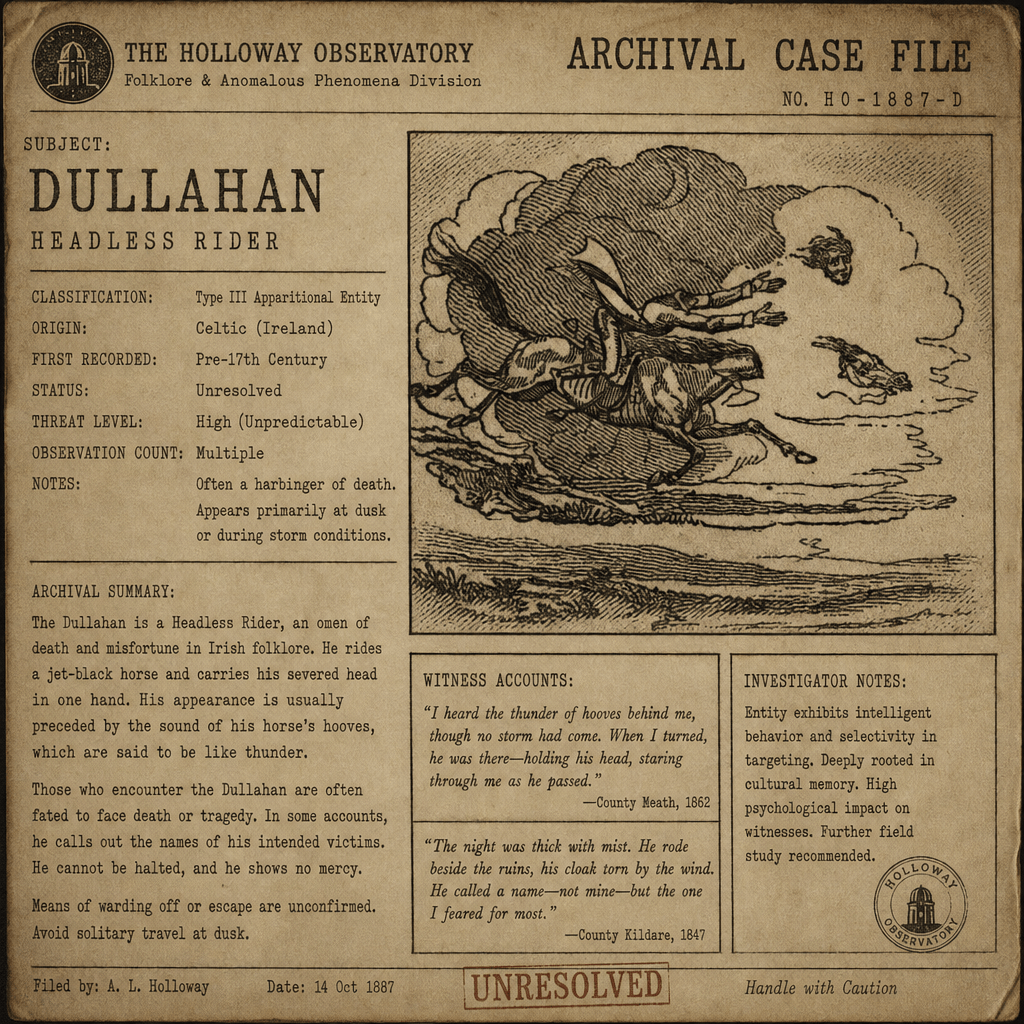
The Dullahan appears in Irish folklore as a headless rider who moves between the living and the dead. Most accounts describe the figure mounted on a black horse, carrying its own severed head in one hand while the other grips a whip fashioned from a human spine. The creature is neither demon nor ghost but a harbinger — a being whose arrival signals that a life is about to end.
Origins
The Dullahan’s earliest roots lie in pre‑Christian Ireland, where it is often linked to the ancient fertility god Crom Cruach. According to tradition, human sacrifices were once offered to this deity, and when such rites were abolished, Crom’s role as a taker of life transformed into the figure of the Dullahan. Over time, the myth shifted from a god demanding offerings to a solitary rider who appears only to announce death.
The name itself comes from dullachán, meaning “dark man” or “without a head,” a literal description of the creature’s form.
Appearance and Behavior
The Dullahan’s severed head is said to glow faintly, allowing it to see across great distances. Its face is often described as decayed or stretched into a permanent grin. The horse it rides is equally unsettling — black, wild‑eyed, and sometimes breathing sparks or mist.
The Dullahan does not wander aimlessly. It travels with purpose, stopping only when it reaches the home of the person whose life is about to end. In many stories, the creature does not speak; instead, it simply calls the name of the doomed, and the soul departs instantly. No door or gate can bar its path. Locks fall open, and barriers give way as if compelled by an unseen force.
Weaknesses and Wards
Unlike many supernatural beings, the Dullahan cannot be driven off by prayer or charm. The only substance said to repel it is gold — even a small amount can force the rider to turn away. This detail appears in several regional tales and may reflect older beliefs about gold’s protective or sacred qualities.
Legacy
The Dullahan remains one of Ireland’s most enduring death omens, a figure that blends ancient ritual memory with later folklore. Its image — the headless rider, the black horse, the whispered name — has influenced modern literature and media, though often in altered form. Despite these adaptations, the core of the legend persists: a silent messenger who appears only once, and never without purpose.
End of Record
The Dullahan remains one of Ireland’s most enduring death omens — a silent rider who appears only with purpose, and never without consequence. Its legend endures in the space between fear and reverence, where old gods and old stories still cast long shadows.
References
- Croker, Thomas Crofton. Fairy Legends and Traditions of the South of Ireland. United Kingdom: John Murray, 1828.
- Nightstalkers: Fangs & Fur, Book 2. N.p.: Amber Book Company, 2022.
- “From Celtic Lore to Modern Fear: The Enduring Legacy of the Dullahan.” The Horror Dome, September 3, 2023, https://www.thehorrordome.com/blogs/news/from-celtic-lore-to-modern-fear-the-enduring-legacy-of-the-dullahan.
- “Dullahan – Mythos Anthology.” Mythos Anthology, 2024, https://mythosanthology.com/dullahan/.
- “Dullahan: A Mythical Headless Horseman.” Mythical Encyclopedia, 2024, https://mythicalencyclopedia.com/dullahan/.
- “Dullahan – Wikipedia.” Wikipedia, Wikimedia Foundation, October 11, 2024, https://en.wikipedia.org/wiki/Dullahan.
- “The Dullahan: Ireland’s Headless Horseman and Harbinger of Death.” Irish History, 2024, https://www.irishhistory.com/myths-legends/mythical-creatures/the-dullahan-irelands-headless-horseman-and-harbinger-of-death.
Fairy Legends and Traditions of the South of Ireland by Thomas Crofton Croker can be read in its entirety for free at Google Books.
© 2026 Chandra Martin. All Rights Reserved.
All original research, writing, analysis, and historical synthesis on this site is the intellectual property of Chandra Martin. This content may not be copied, reproduced, republished, distributed, adapted, or used in any form—digital or print—without prior written permission from the author.
Limited quotation for academic or educational purposes is permitted only if proper credit is given and the use does not alter the meaning, context, or integrity of the work.
To request permission for use in publications, videos, courses, educational materials, or digital media, please
contact:
Contact
Include:
- Your name
- The specific content you wish to use
- How and where it will be used
- Whether the use is commercial or non-commercial
All requests will be reviewed on a case-by-case basis.
Make a one-time donation
Make a monthly donation
Make a yearly donation
Choose an amount
Or enter a custom amount
Your contribution is appreciated.
Your contribution is appreciated.
Your contribution is appreciated.
 Chandra Martin