

The James Ossuary is a first-century limestone burial box inscribed with “James, son of Joseph, brother of Jesus” in Aramaic. Discovered in Israel, it’s believed to have held the remains of James the Just, a key figure in early Christianity. The ossuary gained worldwide attention in 2002, sparking debate over its authenticity. Experts were divided, with some asserting it as genuine and others claiming the inscription was forged. Despite the controversy, it remains a significant artifact in the study of early Christianity and the historical Jesus.
Table of Contents
- Introduction
- The Discovery and Initial Reactions
- The Controversy and Scientific Investigations
- Religious and Theological Implications
- The Ossuary Today
- Conclusion
- FAQs
- Sources
Introduction
The James Ossuary is a simple limestone box with an Aramaic inscription that reads, “James, son of Joseph, brother of Jesus.” Discovered in Israel in 2002, it has been the subject of much discussion and study. Believed to have held the bones of James the Just, an important figure in early Christianity, the ossuary provides a potential link to the historical Jesus. Scholars and historians continue to debate its authenticity and significance, but it remains an interesting artifact in the study of religious history.
The Discovery and Initial Reactions

Circumstances of the Discovery
Oded Golan, an Israeli engineer and antiquities collector, acquired the James Ossuary in 1976 from an antiquities dealer in Jerusalem. He purchased it without knowing the full significance of the inscription, and it remained part of his private collection until October 21, 2002, when it was publicly revealed at a press conference by the Discovery Channel and the Biblical Archaeology Society. The announcement stirred interest and debate because of its possible link to James, the brother of Jesus.
Initial expert examinations suggested that the inscription was authentic and from the first century. However, the Israel Antiquities Authority (IAA) later claimed it was a modern forgery. This led to a lengthy legal case, with Golan facing charges of forgery, fraud, and deception. In 2012, he was acquitted of forgery but convicted of illegal trading in antiquities. Golan has stated that he never tried to profit from the ossuary and that he acquired it out of a love for antiquities.
The Inscription and Its Translations

The inscription on the James Ossuary is written in Aramaic, the common language of Jews in the first century. It says, “Ya’akov bar Yosef akhui di Yeshua,” which translates to “James, son of Joseph, brother of Jesus.”
There are different interpretations of the James Ossuary inscription. The most accepted translation is “James, son of Joseph, brother of Jesus,” but some scholars debate the nuances and context. A key issue is whether the inscription is authentic or a modern forgery, leading to questions about its connection to James, the brother of Jesus of Nazareth.
“James,” “Joseph,” and “Jesus” were common names in the first century, so the ossuary might refer to other individuals with those names. Another debate is the absence of a more specific title for Jesus. If the inscription referred to the biblical figures, some believe it would have included a title like “Jesus of Nazareth” or “Jesus the Christ” to distinguish him from others. It’s unusual for an ossuary to mention a brother unless the brother was well-known or important, which adds to the ongoing debate about the inscription’s authenticity and its historical importance.
Reactions from Religious and Academic Circles
The revelation of the James Ossuary in 2002 sparked interest among religious communities and historians. Many Christians saw it as a possible connection to Jesus and his family, hoping it could offer historical support for biblical accounts. The press conference and media coverage added to the enthusiasm.
However, there was also significant skepticism from academic and archaeological experts. The Israel Antiquities Authority (IAA) questioned the authenticity of the inscription, suggesting it might be a modern forgery. Scholars pointed out inconsistencies in the patina and the Aramaic inscription style. The fact that the ossuary wasn’t found in a controlled excavation also raised concerns.
Initial analyses were mixed. The Geological Survey of Israel tested the patina and found it consistent with ancient ossuaries, which supported the idea of authenticity. Despite this, doubts persisted, leading to a detailed investigation and a legal battle involving the ossuary’s owner, Oded Golan, who was charged with forgery and fraud.
The Controversy and Scientific Investigations
Arguments for and Against the Ossuary’s Authenticity
The authenticity of the James Ossuary has been widely debated among scholars and experts. Supporters point to paleographic analysis, showing that the Aramaic letters match first-century styles. Experts like André Lemaire from the Sorbonne and Ada Yardeni from the Hebrew University of Jerusalem have confirmed the inscription as genuine. The Geological Survey of Israel tested the patina and found it consistent with ancient ossuaries, supporting the idea that the inscription could be authentic. The ossuary dates back to a time when collecting bones (ossilegium) was common among Jews, and the inscription fits historical records of James, the brother of Jesus.
On the other hand, some argue against its authenticity. The Israel Antiquities Authority (IAA) and other scholars suggest the inscription is a modern forgery, citing inconsistencies in the patina and the style of the inscription, implying it was added later. The ossuary’s unclear origin, since it was purchased without a verified history, adds to the skepticism. Legal proceedings intensified the debate when the ossuary’s owner, Oded Golan, was charged with forgery and fraud. Although he was acquitted of forgery in 2012, the question of the inscription’s authenticity remains unresolved.
Scientific Methods
Several scientific methods were used to analyze and date the James Ossuary. One key technique was patina analysis, carried out by the Geological Survey of Israel. This involved studying the surface layer that forms on ancient ossuaries over time. By examining the composition of minerals like apatite, whewellite, and weddelite, experts checked if it matched what is typically found on ancient artifacts. The presence of these minerals supported the idea that the ossuary itself is genuine and dates back to the first century. However, some experts argued that the patina on the inscription appeared different, raising suspicions of modern forgery.
Another method was examining the toolmarks on the ossuary. Experts looked closely at the striations and wear patterns on the inscription to determine if ancient tools were used. This was to check for signs of modern forgery. This examination supported the argument that the inscription could be authentic.
The ossuary was bought without a clear archaeological origin, which raised questions about its authenticity. Without a verified archaeological context, it was hard to confirm the ossuary’s historical background. Although radiometric dating wasn’t done directly on the ossuary, it was used on similar artifacts from the same time to create a timeline. This helped place the James Ossuary within its historical context.
A multidisciplinary approach was also used, with experts from fields like archaeometry, materials science, and historical archaeology working together to verify the authenticity of the ossuary and inscription. While this comprehensive approach provided valuable insights, it did not conclusively prove the authenticity of the inscription.
Religious and Theological Implications
Implications of Authenticity, or Lack Thereof
The authenticity of the James Ossuary has important implications for both Christian theology and history. If the ossuary and its inscription are genuine, it would provide evidence of Jesus’ family, specifically confirming the existence of James, Jesus’ brother. This could help support the historical foundation of the New Testament and connect us to the early Christian community.
On the other hand, if the ossuary turns out to be a forgery, it would raise questions about the reliability of some historical artifacts and why forgeries are made. It could also lead to a reassessment of how ancient artifacts are authenticated and the role of provenance in archaeological discoveries.
Interpretations and Perspectives
The James Ossuary has sparked different views within religious communities. For many Christians, it offers a possible connection to Jesus and his family, which could support biblical accounts and strengthen faith. Some see it as an important discovery that backs the existence of Jesus and his brother James, providing historical evidence that aligns with Christian teachings.
However, there are other perspectives within religious circles. Some theologians suggest the inscription might refer to a close relative or spiritual brother of Jesus, rather than his literal brother, due to the belief in Mary’s perpetual virginity. In this view, even if the ossuary is authentic, it may not carry the same theological weight.
There are also skeptics who question the ossuary’s authenticity and consider it a possible forgery. These individuals call for thorough scientific verification and caution against drawing conclusions based on the artifact alone.
The Ossuary Today
The Current Status
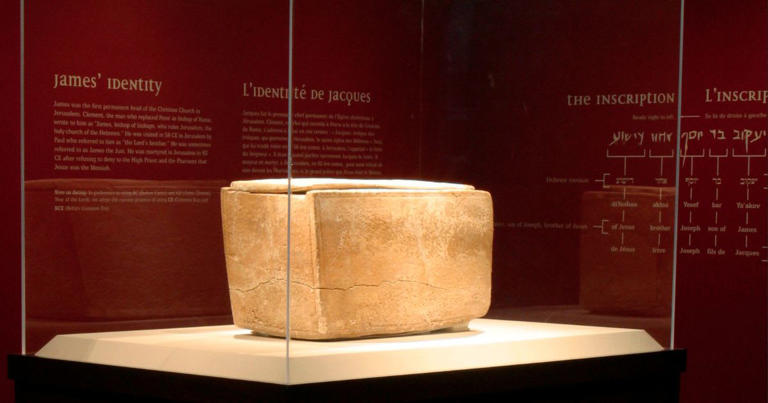
The James Ossuary is currently owned by Oded Golan, the Israeli engineer and antiquities collector who discovered it. After being acquitted of forgery charges in 2012, Golan put the ossuary on public display at Pullman Yards in Atlanta, Georgia. It is part of an exhibit titled “Discovering the World of Jesus: Ancient Treasures from the Holy Land,” which features over 350 artifacts from the private collection of Oded Golan. This exhibit aims to provide historical context to the life and times of Jesus, offering visitors a unique opportunity to connect with objects from the period.
As for what experts think, the opinions are still divided. The Israel Antiquities Authority (IAA) maintains that the inscription is a modern forgery, pointing to issues with the patina and toolmarks. However, some scholars, like André Lemaire and Ada Yardeni, believe the inscription is real based on their analysis of the paleography and patina. Because there’s no clear conclusion, the debate over the ossuary’s authenticity continues.
Ongoing Debates
Investigations and research into the James Ossuary are still ongoing. Scholars and experts continue to study the artifact using advanced scientific methods and historical analysis. One area of focus is DNA testing, which aims to see if the bones found in the ossuary can be linked to known historical figures or family members. This testing could offer valuable information about the people connected to the ossuary.
Researchers are also looking into tombs in East Talpiot, the Hinnom Valley, and the Mount of Olives. They hope to find more evidence that might link the ossuary to other discoveries. Studying tombs and burial practices helps to understand the historical and cultural background of the ossuary.
Paleographic analysis is another key part of the research. Experts are carefully examining the style and form of the inscription, comparing it with other first-century writings to check its authenticity. This analysis aims to settle the question of whether the inscription is genuine or a modern forgery.
Conclusion
The James Ossuary remains one of the most debated artifacts in the study of early Christianity. The simple limestone box, with the Aramaic inscription “James, son of Joseph, brother of Jesus,” has sparked both interest and skepticism since it was revealed in 2002. Some experts believe the ossuary is authentic, providing a connection to James the Just and the historical Jesus, while others question its authenticity due to inconsistencies and the lack of a clear archaeological history.
The scientific tests, legal issues, and ongoing research into the ossuary show how difficult it can be to verify ancient artifacts and how faith, history, and science come together. Whether it’s genuine or a forgery, the James Ossuary continues to interest both scholars and religious groups, highlighting the ongoing effort to uncover the past and understand our shared history. As the debate continues, the ossuary serves as a reminder of the complexity of our historical and cultural stories.
“If the inscription is genuine, it would be the first direct archaeological evidence of the existence of Jesus and his family.” – André Lemaire
Frequently asked questions about the James Ossuary
- Is the authenticity of the James Ossuary confirmed?
- The authenticity of the James Ossuary has not been conclusively confirmed. While some experts, including André Lemaire and Ada Yardeni, believe the inscription is genuine, others, such as the Israel Antiquities Authority, maintain that it is a modern forgery. The legal proceedings ended with Oded Golan’s acquittal on forgery charges in 2012, but the debate over the ossuary’s authenticity continues.
- What makes the inscription on the ossuary so important?
- The inscription on the James Ossuary is crucial because it potentially provides the first direct archaeological evidence of Jesus and his family. If authentic, it could corroborate historical accounts of James, the brother of Jesus, offering a tangible link to early Christian history. The mention of familial relationships on an ossuary is rare and adds to its significance.
- What are the main arguments against its authenticity?
- The main arguments against the authenticity of the James Ossuary are inconsistencies in the patina on the inscription, toolmarks that suggest modern forgery, the lack of clear archaeological provenance, and evidence presented during the trial, despite Oded Golan’s acquittal. These factors contribute to the ongoing debate about whether the inscription is genuine.
- Where did Oded Golan get the ossuary?
- Oded Golan acquired the James Ossuary in 1976 from an antiquities dealer in Jerusalem.
Sources
- Resurrecting the Brother of Jesus: The James Ossuary Controversy and the Quest for Religious Relics. United States: University of North Carolina Press, 2009. (Internet Archive)
- Shanks, Hershel., Witherington, Ben., Witherington, Ben. The Brother of Jesus: The Dramatic Story and Significance of The First Archaeological Link to Jesus and His Family. Ireland: Bloomsbury, 2003. (Internet Archive)
- Burleigh, Nina. Unholy Business: A True Tale of Faith, Greed and Forgery in the Holy Land. United States: HarperCollins, 2008. (Internet Archive)
- Pellegrino, Charles., Jacobovici, Simcha., Cameron, James. The Jesus Family Tomb. United States: HarperCollins, 2008. (Internet Archive)
- Wikipedia contributors. 2024. “James Ossuary.” Wikipedia. November 23, 2024. https://en.wikipedia.org/wiki/James_Ossuary.
- Wikipedia contributors. 2024. “Oded Golan.” Wikipedia. November 10, 2024. https://en.wikipedia.org/wiki/Oded_Golan.
- Holden, Joseph, PhD. 2022. “The James Ossuary: The Earliest Witness to Jesus and His Family?” Calvary Chapel. April 23, 2022. https://calvarychapel.com/posts/the-james-ossuary-the-earliest-witness-to-jesus-and-his-family/.
- “Oded Golan Is Not Guilty of Forgery. So Is the ‘James Ossuary’ for Real? | the Times of Israel.” 2012. The Times of Israel. March 14, 2012. https://www.timesofisrael.com/oded-golan-is-not-guilty-of-forgery-so-is-the-james-ossuary-for-real/.
- Staff, Biblical Archaeology Society. 2023. “Is The ‘Brother of Jesus’ Inscription on the James Ossuary a Forgery? – Biblical Archaeology Society.” Biblical Archaeology Society. September 26, 2023. https://www.biblicalarchaeology.org/daily/biblical-artifacts/artifacts-and-the-bible/is-the-brother-of-jesus-inscription-on-the-james-ossuary-a-forgery/.
- Staff, Biblical Archaeology Society. 2019. “What You Need to Know Before the James Ossuary Forgery Trial Verdict – Biblical Archaeology Society.” Biblical Archaeology Society. May 31, 2019. https://www.biblicalarchaeology.org/daily/biblical-artifacts/artifacts-and-the-bible/what-you-need-to-know-before-the-james-ossuary-forgery-trial-verdict/.
- Klett, Leah MarieAnn. 2024. “James’ Ossuary Unveiled in New ‘World of Jesus’ Exhibit With Over 350 Artifacts From Holy Land.” The Christian Post, December 22, 2024. https://www.christianpost.com/news/holy-land-artifacts-unveiled-in-discovering-the-world-of-jesus.html.
- “What’s the Latest on the ‘James Son of Joseph, Brother of Jesus’ Ossuary? – TaborBlog.” 2022. November 23, 2022. https://jamestabor.com/whats-the-latest-on-the-james-son-of-joseph-brother-of-jesus-ossuary/.
- [your]NEWS. 2024. “Ancient Bone Box Tied to Jesus’ Brother James Now on Display in Atlanta – [Your]NEWS.” [Your]NEWS – Ancient Bone Box Tied to Jesus’ Brother James Now on Display in Atlanta – the James Ossuary, Hailed as a Groundbreaking Biblical Artifact, Has Arrived in the U.S., Drawing Attention for Its Potential Connection to Jesus’ Family. December 25, 2024. https://yournews.com/2024/12/25/2988193/ancient-bone-box-tied-to-jesus-brother-james-now-on/.
- “Ossuary Verdict: Experts Testify to Its Authenticity.” 2012. United Church of God. https://www.ucg.org/good-news/good-news-magazine-may-june-2012/ossuary-verdict-experts-testify-its-authenticity.
- “Does the ‘James Ossuary’ Bring Us Closer to Jesus?” 2003. The University of Chicago Divinity School. https://divinity.uchicago.edu/sightings/articles/does-james-ossuary-bring-us-closer-jesus.
- “Bone Box Inscribed with Name of Jesus’ Brother Unveiled as ‘Most Significant Relic from Time of Christ’ – Catholic Online News.” 2024. December 20, 2024. https://catholiconline.news/faith/bone-box-inscribed-with-name-of-jesus-brother-unveiled-as-most-significant-relic-from-time-of-christ/.
- Exile, J. (n.d.). The James Ossuary: Discovery and Significance. Joyful Exile. https://www.joyfulexile.com/biblical-archaeology/james-ossuary
- “Implications of the “Forgery Trial” Verdict on the Authenticity of the James Ossuary.” Bible Interp, Arizona Center for Judaic Studies, University of Arizona. Accessed January 15, 2025. https://bibleinterp.arizona.edu/sites/bibleinterp.arizona.edu/files/docs/implications.pdf.
- Publishing, Scientific Research. 2015. “The Authenticity of the James Ossuary.” http://www.academia.edu, March. https://www.academia.edu/11661915/The_Authenticity_of_the_James_Ossuary.
- Tsach, Tsadok, Nir Finkelstein, and Nikolai Volkov. “The James Ossuary: A Forensic Inquiry.” Journal of Historical Archaeology & Anthropological Sciences 2, no. 1 (2017): 1–6. Accessed January 15, 2025. https://medcraveonline.com/JHAAS/JHAAS-02-00039.pdf.
- McGirk, Tim / Jerusalem. 2008. “Fraudulent Relics and the Brother of Jesus.” TIME, October 16, 2008. https://time.com/archive/6944663/fraudulent-relics-and-the-brother-of-jesus/.
- Moreland, Milton. 2009. “Christian Artifacts in Documentary Film.” In University of North Carolina Press eBooks, 73–136. https://doi.org/10.5149/9780807895498_byrne.8.
- Jackson, Jesse T. 2025. “Bible Exhibit Showcases Box Believed to Have Held the Bones of James, Brother of Jesus.” January 2, 2025. https://churchleaders.com/news/503112-bible-exhibit-showcases-box-believed-to-have-held-the-bones-of-james-brother-of-jesus.html.
- Liberatore, Stacy. 2024. “Bone Box of Jesus’ Brother Discovered in Israel Deemed ‘most Significant Item from Time of Christ.’” Mail Online, December 20, 2024. https://www.dailymail.co.uk/sciencetech/article-14214411/bone-box-jesus-brother-discovered-israel-time-christ.html.
© 2026 Chandra Martin. All Rights Reserved.
All original research, writing, analysis, and historical synthesis on this site is the intellectual property of Chandra Martin. This content may not be copied, reproduced, republished, distributed, adapted, or used in any form—digital or print—without prior written permission from the author.
Limited quotation for academic or educational purposes is permitted only if proper credit is given and the use does not alter the meaning, context, or integrity of the work.
To request permission for use in publications, videos, courses, educational materials, or digital media, please
contact:
Contact
Include:
- Your name
- The specific content you wish to use
- How and where it will be used
- Whether the use is commercial or non-commercial
All requests will be reviewed on a case-by-case basis.
 Chandra Martin