

Born Esther Elizabeth Rolle on November 8, 1920 in Pompano Beach, Florida to Johnathan Rolle and Elizabeth (née Dames), she was the tenth of 18 children. She is best known for her portrayal of Florida Evans on the sitcoms Maude and Good Times, which aired from 1974 to 1979. She received a Primetime Emmy nomination for Outstanding Supporting Actress in a Comedy or Musical for her role in Good Times in 1975.
Table of Contents
- Introduction
- Early Life and Background
- Breakthrough Role: Florida Evans
- Beyond “Good Times”
- Legacy and Influence
- Illness and Death
- Conclusion
- FAQs
- Sources
Introduction
Esther Rolle was not just an actress—she was a trailblazer who made an impact on TV and society. Her role as Florida Evans on Good Times broke barriers and set an example for showing real Black American life on screen. Her acting was more than entertainment; it showed strength and dignity. By looking at her career and dedication to her work, we can see the legacy she left behind.
“I told them [the producers] I couldn’t compound the lie that Black fathers don’t care about their children. I was proud of the family life I was able to introduce to television.” – Esther Rolle
Early Life and Background
Born
Esther Elizabeth Rolle was born on November 8, 1920, in Pompano Beach, Florida. She was the tenth of eighteen children in a big, loving family. Her parents, Jonathan and Elizabeth Rolle, were Bahamian immigrants who moved to Florida after their marriage. Rolle’s father was a Baptist minister and farmer, and her mother took care of the family at home. The family lived in a rural farming community.
Esther Rolle’s parents taught her the importance of hard work, community, and cultural pride. Growing up on a farm in a large family, she learned the value of family unity and support. Her parents encouraged their children to stay strong, work hard, and value education, even when life was difficult.
Their Bahamian heritage also shaped Esther’s identity and inspired her to represent Black American and Caribbean cultures honestly in her acting career.
Education
While attending Booker T. Washington High School in Miami, Rolle and her siblings formed a drama troupe. They performed in churches along the East Coast. She graduated from Blanche Ely High School in Pompano Beach, Florida.
She started at Spelman College in Atlanta, Georgia in 1942, where she studied drama and the arts, building her love for performing. After moving to New York City, she attended Hunter College to continue studying drama and theater.
In addition to her time at Hunter College, Rolle also took classes at The New School, learning about social work and the arts, which deepened her understanding of social issues and her dedication to helping her community. She also studied drama, dance, and literature at Yale University to improve her skills even more.
While living in New York, Rolle worked various jobs in the garment district to support herself while studying.
Theatre Beginnings

Esther Rolle started her artistic career as a dancer in the Shogolo Oloba dance troupe, led by Asadata Dafora, a choreographer from Sierra Leone who brought African dance to America. Her hard work and talent stood out, and in 1960, she became the troupe’s director. Under her guidance, the group performed at famous places like Carnegie Hall and the Apollo Theater.
Esther Rolle began her acting career with the Negro Ensemble Company in New York City. She made her stage debut in 1962 in the play The Blacks, directed by Robert Hooks. Her strong performances quickly gained attention from audiences and critics. She acted in several productions with the company, including Blues for Mr. Charlie and The Amen Corner.
One of her standout early roles was playing Miss Maybell in Melvin Van Peebles’ Broadway musical Don’t Play Us Cheap in 1972, which was later made into a movie in 1973.
Marriage
In 1955, Esther Rolle married Oscar Robinson. The marriage ended in divorce in 1975. Oscar Robinson had one daughter from a previous marriage. Oscar and Esther did not have any children together.
Breakthrough Role: Florida Evans
Good Times Overview
“Good Times” was an American TV show that aired on CBS from February 8, 1974, to August 1, 1979. It was created by Eric Monte and Mike Evans, and produced by Norman Lear. It was the first TV show to feature a Black American two-parent family. The show was a spin-off of “Maude,” which came from another show called “All in the Family.”
The show is about the Evans family, who live in a public housing project in a poor, black neighborhood in Chicago. The family includes Florida and James Evans, their three children—James Jr. (J.J.), Thelma, and Michael—and their friendly neighbor, Willona Woods, who is Florida’s best friend. The show shows how the family faces challenges but stays strong and keeps their humor.
James Evans is a hard-working man who doesn’t always agree with his son J.J., who wants to be an artist and is carefree. Thelma is focused on her education and future, while Michael cares about social justice. Willona is there to support Florida, often as a good friend. Nathan Bookman, the building superintendent, is a regular character who is often the target of jokes.
Rolle’s Character
Florida Evans first appeared on the TV show “Maude” in 1972 as Maude Findlay’s housekeeper. Her character was so popular that she got her own show, “Good Times,” which started in 1974.
In “Good Times,” Florida Evans is shown as a strong, loving mother who works hard to keep her family together, even though they face many challenges living in a Chicago housing project. She is the voice of reason in her family, known for her wisdom, humor, and strong commitment to her family’s well-being.
Esther Rolle’s performance as Florida Evans earned her a Golden Globe nomination for Best Actress in a Television Series Musical or Comedy in 1976. Her role as Florida helped show a positive and realistic Black American family on TV, and her work is still remembered for improving how Black Americans were represented in media.
Cultural Impact
Esther Rolle’s role as Florida Evans on “Good Times” had a big impact on how Black American families were shown on TV. The show was one of the first to focus on a working-class Black family, dealing with real issues like poverty, racism, and economic struggles. Florida Evans, as the mother, represented strength, resilience, and love.
Rolle worked hard to make sure the show showed Black families in a true way, not falling into the stereotypes often seen in the media. She made sure that Florida’s husband, James Evans, was an important part of the family, challenging the common idea of the absent Black father. This was a big step forward in showing a more positive and real picture of family life.
“Good Times” connected with viewers through its humor and honest look at family life during tough times. It showed the challenges families face while also celebrating their strength and resilience. The show’s impact is still felt today, as it opened the door for more realistic portrayals of Black families on TV.
Beyond “Good Times”
Film and Television Work
After “Good Times” ended in 1979, Esther Rolle continued acting in movies and TV shows. She appeared in several TV movies, like “Summer of My German Soldier” (1978), for which she won an Emmy Award for Outstanding Supporting Actress in a Limited Series or Special. She also had roles in movies like “Driving Miss Daisy” (1989) and “My Fellow Americans“ (1996).
One of her well-known film roles was as Aunt Sarah in the 1997 movie “Rosewood,” which told the story of the Rosewood massacre. Her performance in this film was praised for its emotional depth.
In addition to movies, Rolle kept acting on TV in guest roles and TV movies.
Advocacy
Esther Rolle strongly supported showing Black American families honestly in the media. She was against negative stereotypes, especially the idea that Black fathers were absent or not involved. When “Good Times” was being made, Rolle made sure the show included a strong, present father, James Evans, played by John Amos. This was a big change from the usual stereotypes and helped show a more positive and true picture of Black family life.
Rolle’s advocacy went beyond her acting. In 1990, she became the first woman to win the NAACP Chairman’s Civil Rights Leadership Award for her work in improving the image of Black people through TV, film, and theater. She also spoke out about her concerns with the character J.J. on “Good Times,” believing that his silly behavior wasn’t a good example for Black youth.
Legacy and Influence
Awards and Accolades
Esther Rolle received many awards throughout her career for her work in the arts and her efforts to show Black American families in a true light. She won a Primetime Emmy Award in 1979 for Outstanding Supporting Actress in the TV movie “Summer of My German Soldier“. This award recognized her talent and influence in TV. In 1976, she was nominated for a Golden Globe for Best TV Actress – Comedy or Musical for her role as Florida Evans on “Good Times“.
Rolle also earned several NAACP Image Award nominations for her work in “Good Times” and “Rosewood“. In 1987, she was added to the NAACP Hall of Fame, showing her lasting influence in the arts. In 1990, she became the first woman to receive the NAACP Chairman’s Civil Rights Leadership Award for her efforts to improve the image of Black people in TV, film, and theater. She was also nominated for a TV Land Award in 2004 for Favorite Made for TV Maid for her role as Florida Evans on “Maude“.
Influence of Future Generations
Esther Rolle’s impact goes beyond her acting roles. She was a pioneer in the entertainment world and inspired many young actors and actresses to follow their dreams in an industry that often overlooked their talents. By taking on strong roles that showed the strength and dignity of Black Americans, she set an example for future generations. Her focus on real and fair representation, along with her work for social justice, made her a respected figure in Hollywood and beyond.
Many current artists look up to Esther Rolle as an inspiration. Her work helped open doors for more diverse and realistic portrayals of Black families in movies and TV shows. Through her support and guidance, she also helped other Black artists succeed and grow, lifting up her community.
Community Efforts
Esther Rolle was very dedicated to her community and used her fame to push for social change and support others. She worked hard to make sure Black Americans were shown in a positive light in media, especially Black families, portraying them with respect and truth. Rolle made sure that “Good Times” included a strong, involved father figure, helping to break harmful stereotypes and show a more accurate picture of Black family life.
Outside of acting, Rolle was active in community programs and helped guide young Black artists. She supported them in finding success in the entertainment world.
Rolle’s legacy is remembered through events like the “Reflections of Esther” art show in her hometown of Pompano Beach. These events honor her work and her fight for real representation.
Illness and Death
In the early 1990s, Esther Rolle was diagnosed with diabetes, but she continued working in TV and film while managing the condition. Even though she was sick, she stayed active and focused on her work.
As time went on, her health got worse. She was hospitalized several times because of complications from diabetes.
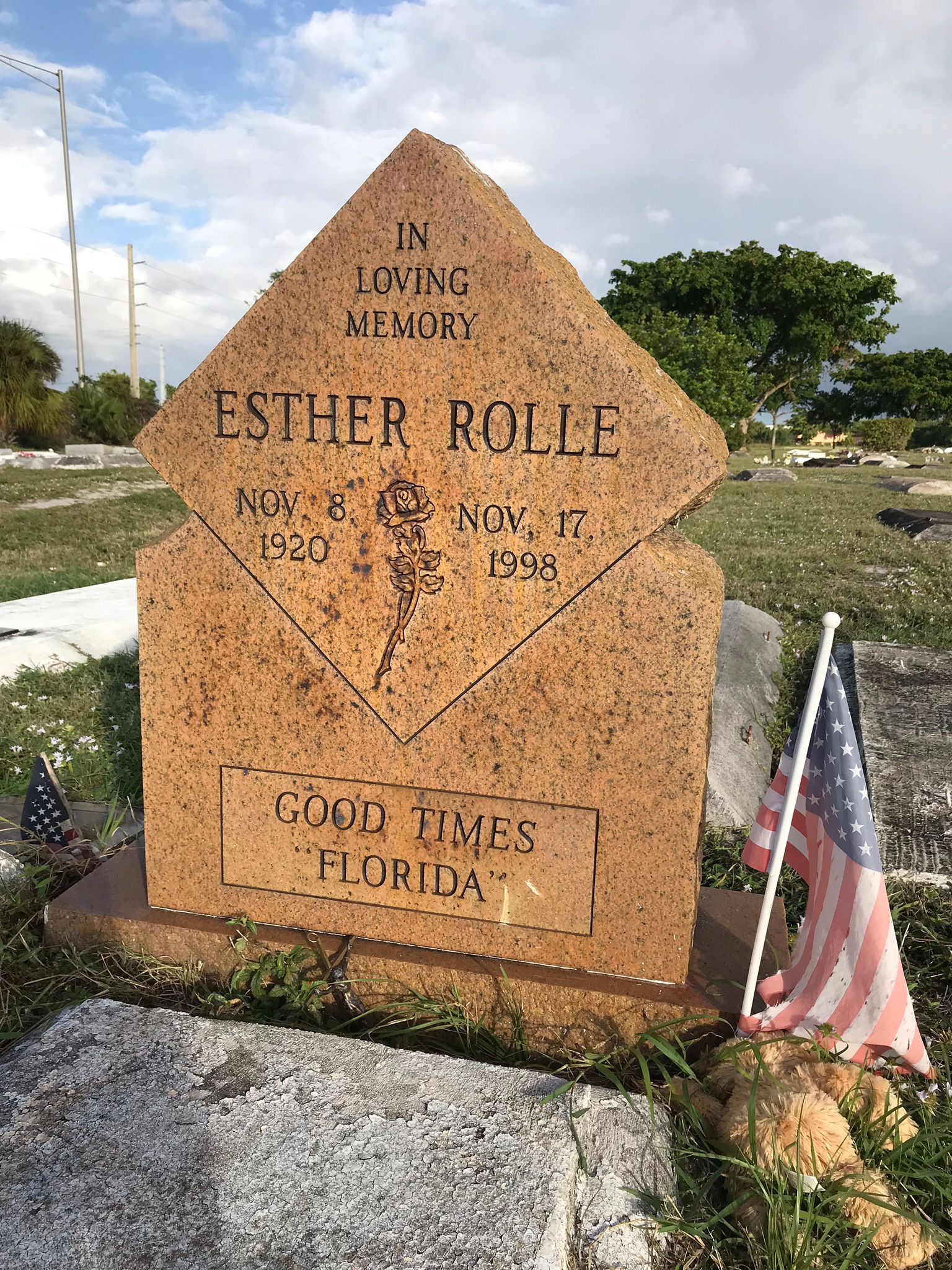
Esther Elizabeth Rolle died on November 17, 1998, in Culver City, California, from complications of diabetes, nine days after her 78th birthday. A devout member of the African Methodist Episcopal Church, Rolle requested that her funeral be held at Bethel African Methodist Episcopal Church. She is buried in Westview Community Cemetery in Pompano Beach, Florida.
Conclusion
Esther Rolle’s life and career show her amazing talent, hard work, and dedication to showing real Black American experiences. She was born on November 8, 1920, in Pompano Beach, Florida, in a close and hardworking family that taught her the values of community, cultural pride, and strength. These values guided her throughout her life, from dancing with the Shogolo Oloba dance troupe to becoming a well-known actress.
Rolle studied at schools like Spelman College, Hunter College, The New School, and Yale University, which helped her build a strong background in the arts and social work. Her work with the Negro Ensemble Company and her role as Florida Evans on “Good Times” made her a loved star on TV, breaking stereotypes and showing Black American families with respect and depth.
Rolle worked hard to ensure people saw real, fair representations of Black Americans, earning her many awards, including a Primetime Emmy Award and the NAACP Chairman’s Civil Rights Leadership Award. Even when she faced health issues, like diabetes, she continued to inspire others and help her community.
Esther Rolle’s legacy is remembered for her cultural influence, her dedication to acting, and her strong commitment to showing the true stories of Black American life. Her work reminds us of how important representation is and the power of strength in the human spirit.
Frequently asked questions about Esther Rolle
- Who was Esther Rolle? Esther Rolle was an American actress best known for her role as Florida Evans on the 1970s sitcoms “Maude” and its spin-off “Good Times”. Born on November 8, 1920, in Pompano Beach, Florida, she was the tenth of 18 children of Bahamian immigrant parents. Rolle’s career spanned stage, television, and film, and she was known for her strong, spirited performances. She won an Emmy Award in 1979 for her role in the television film “Summer of My German Soldier”. Rolle passed away on November 17, 1998, due to complications from diabetes.
- When was Esther Rolle born? She entered the world on November 8, 1920, in the sunny town of Pompano Beach, Florida.
- What was Esther Rolle’s most famous role? Esther Rolle gained widespread recognition for her portrayal of Florida Evans in the television series “Maude” and its spin-off “Good Times.”
- Did Esther Rolle win any awards? Indeed, she received the Primetime Emmy Award for Outstanding Supporting Actress in a Limited Series or a Special for her role in “Summer of My German Soldier” in 1979.
- When did Esther Rolle die? She died on November 17, 1998, in Culver City, California.
- What was Esther Rolle’s background? Esther Rolle was born on November 8, 1920, in Pompano Beach, Florida, to Bahamian immigrant parents. She was the tenth of 18 children in her family. Rolle pursued education at Spelman College in Atlanta before moving to New York to study acting. She became active in the theater, particularly with the Negro Ensemble Company, and gained recognition for her work on stage and screen, most notably for her role as Florida Evans on the sitcoms “Maude” and “Good Times”.
- Was Esther Rolle involved in any social issues? Yes, Esther Rolle was involved in social issues. She was known for her outspokenness on matters of racial and gender equality. Rolle left the show “Good Times” in 1977, citing her discomfort with the show’s decline into stereotypical humor. She was also involved in charitable activities, including women’s rights issues and urban education reform.
- Did Esther Rolle have any siblings in the entertainment industry? Indeed, Estelle Evans and Rosanna Carter, her sisters, were also in the acting profession. Estelle Evans is known for her roles in films such as “The Quiet One” (1948), “To Kill a Mockingbird” (1962), and “The Learning Tree” (1969). Rosanna Carter had a career in television, stage, and film, appearing in productions like “The Brother from Another Planet” (1984) and TV shows including “Good Times” and “Law & Order”.
Sources
- “Esther Rolle – Actress.” 2001. TV Insider. February 8, 2001. https://www.tvinsider.com/people/esther-rolle/.
- “Esther Rolle Collection | Broward County Library.” February 8, 2020. https://www.broward.org/Library/Research/SpecialCollections/Pages/EstherRolleCollection.aspx.
- Famous African Americans. n.d. “Esther Rolle – Biography and Facts.” FAMOUS AFRICAN AMERICANS. https://www.famousafricanamericans.org/esther-rolle.
- Shaw, A.R. 2016. “10 Powerful Women Who Attended Spelman College.” Rolling Out, April 14, 2016. https://rollingout.com/2016/04/11/10-powerful-women-attended-spelman-college/.
- Bodego, Joe. 2023. “Esther Rolle.” SamePassage (blog). August 12, 2023. https://samepassage.org/esther-rolle/.
- Fearn-Banks, K. (2007, July 31). Esther Rolle (1920-1998). BlackPast.org. https://www.blackpast.org/african-american-history/rolle-esther-1920-1998/.
- “Turner Classic Movies – TCM.com.” n.d. Watch TCM. https://www.tcm.com/tcmdb/person/164459%7C49207/Esther-Rolle#biography.
- “The New York Times: Best Pictures.” December 13, 1989. https://archive.nytimes.com/www.nytimes.com/packages/html/movies/bestpictures/daisy-re.html.
- Bet. 2017. “Where Are They Now? The Cast of ‘Rosewood.’” BET, February 21, 2017. https://www.bet.com/article/6ujojn/where-are-they-now-the-cast-of-rosewood.
- Wikipedia contributors. 2024. “Esther Rolle.” Wikipedia. October 22, 2024. https://en.wikipedia.org/wiki/Esther_Rolle#.
- “Esther Rolle Collection – Broward County Library Digital Archives.” n.d. https://digitalarchives.broward.org/digital/collection/p16146coll16.
- “Esther Rolle, Star of Stage and ‘Good Times,’ Dies at 78.” 2020. Playbill. January 24, 2020. https://playbill.com/article/esther-rolle-star-of-stage-and-good-times-dies-at-78-com-78589.
- “The Garden of My Mind.” 1975. Spotify. January 1, 1975. https://open.spotify.com/album/0bf9AjxDLZJmRmOuUItniD.
- IMDb. n.d. “Esther Rolle.” IMDb. https://www.imdb.com/name/nm0738354/bio/.
- “Good Times (TV Series 1974–1979) – Plot – IMDb.” n.d. IMDb. https://www.imdb.com/title/tt0070991/plotsummary/.
- Staff, Legacy, and Legacy Staff. 2012. “Esther Let the Good Times Rolle.” Legacy.Com (blog). November 8, 2012. https://www.legacy.com/news/celebrity-deaths/esther-let-the-good-times-rolle/.
- Coverage. 2024. “Unveiling the Legacy of Esther Rolle: A Trailblazer in Entertainment.” InsightfulNews (blog). August 8, 2024. https://d1ba7i5ntl5y75.cloudfront.net/esther-rolle.html.
- Capitalss. 2024. “Esther Rolle: A Trailblazer in Entertainment.” Capital Chronicles (blog). August 8, 2024. https://metromosaic.blob.core.windows.net/informednation22/esther-rolle.html.
- “Collection: Esther Rolle Collection | Broward County Libraries – ArchivesSpace.” n.d. https://broward.lyrasistechnology.org/repositories/2/resources/2.
- Dokosi, Michael Eli, and Michael Eli Dokosi. 2020. “Meet Esther Rolle, the First Woman to Receive NAACP’S Civil Rights Award.” Face2Face Africa, March 7, 2020. https://face2faceafrica.com/article/mesther-rolle-first-woman-to-receive-naacps-civil-rights-award-for-fighting-lies-about-black-fathers.
- Stewart, Shelby. 2024. “‘Good Times’ at 50: Pioneering Black Culture on Television.” Essence, February 8, 2024. https://www.essence.com/entertainment/good-times-50-year-anniversary-lookback/.
- Jmorrisons. 2024. “Why Esther Rolle Fought for a Father Figure in Good Times – a Legacy of Family and Representation.” JCampos Ent (blog). September 10, 2024. https://www.jcamposent.com/post/why-esther-rolle-fought-for-a-father-figure-in-good-times-a-legacy-of-family-and-representation.
- Sage, Tyler. 2022. “45 Years Ago: Esther Rolle Takes a Stand by Leaving ‘Good Times.’” Ultimate Classic Rock. March 30, 2022. https://ultimateclassicrock.com/esther-rolle-leaves-good-times/.
- “Esther Rolle Biography. American Stage and Television Actress.” n.d. https://biographs.org/esther-rolle.
- Find a Grave, database and images (https://www.findagrave.com/memorial/9899/esther-rolle: accessed November 5, 2024), memorial page for Esther Rolle (8 Nov 1920–17 Nov 1998), Find a Grave Memorial ID 9899, citing Westview Community Cemetery, Pompano Beach, Broward County, Florida, USA; Maintained by Find a Grave.
© 2026 Chandra Martin. All Rights Reserved.
All original research, writing, analysis, and historical synthesis on this site is the intellectual property of Chandra Martin. This content may not be copied, reproduced, republished, distributed, adapted, or used in any form—digital or print—without prior written permission from the author.
Limited quotation for academic or educational purposes is permitted only if proper credit is given and the use does not alter the meaning, context, or integrity of the work.
To request permission for use in publications, videos, courses, educational materials, or digital media, please
contact:
Contact
Include:
- Your name
- The specific content you wish to use
- How and where it will be used
- Whether the use is commercial or non-commercial
All requests will be reviewed on a case-by-case basis.
 Chandra Martin