

Imagine living in a world where everyone looks up to you—literally. John William Rogan, also known as “Bud” Rogan, was a towering figure, both in height and in history. Born around 1867 in Tennessee, Rogan grew to an astonishing 8 feet 9 inches, making him the second tallest person ever recorded. Despite facing significant physical challenges due to his extreme height and a condition called ankylosis, Rogan’s story is one of resilience and remarkable stature.
Early Life
John William “Bud” Rogan was born circa 1867 in Hendersonville, Tennessee, and was the fourth born of twelve siblings. His father, William Rogan, was a former slave. The identity of John’s mother is not clearly recorded, and it is speculated that she may not have been married to William.
John experienced a rapid growth spurt at around 13 years old because of gigantism, a condition that caused excessive bone development. Subsequently, he developed ankylosis, which severely stiffened his joints. By the year 1882, his conditions had progressed to the point where he was unable to stand or walk.
Rise to Fame
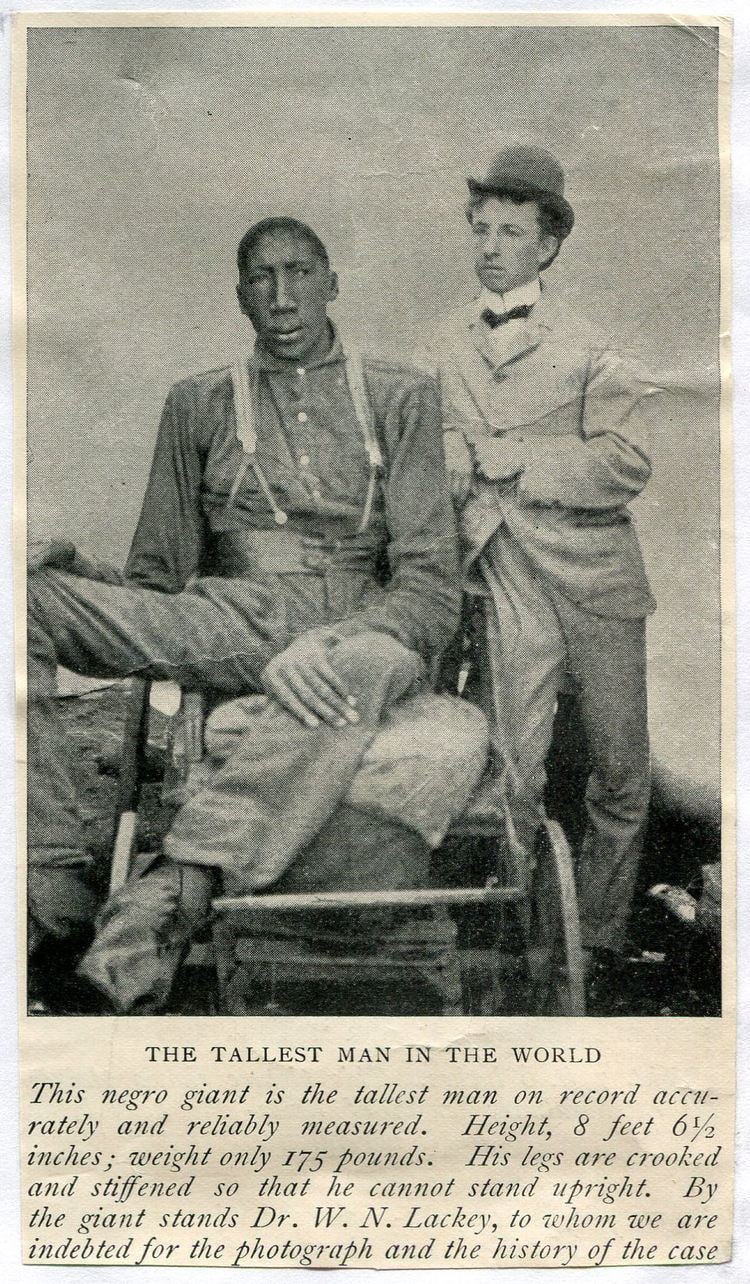
Due to the health issues associated with his height, John sought out Dr. William Lackey‘s medical expertise. Battling ankylosis, John found even walking or standing to be a challenge. Intrigued by John’s condition, Dr. Lackey penned a paper on his case, which subsequently garnered public attention for John’s story.
Following the publication of Dr. William Lackey’s paper, John captured the public’s imagination with his remarkable height and unusual condition. Despite invitations to join carnivals and sideshows, John opted for a more private existence. He found his niche selling portraits and postcards at a train station, where he would greet new arrivals and assist them with their luggage. This lifestyle provided him with a steady income and allowed him to stay away from the relentless travel and exposure associated with the sideshow circuit.
Life Challenges
John’s ankylosis led to the fusion of his knee bones, making walking and standing a challenge. Moreover, his gigantism brought about joint pain, further complicating daily activities. To navigate this, John relied on a goat-pulled cart, which served as a makeshift wheelchair, enabling him to move around despite his walking impairment.
Legacy and Recognition
John was recognized for his playful demeanor and resonant voice. Despite facing challenges associated with his remarkable height and physical condition, he preserved his sense of humor and resilience. Frequently the focus of attention, his charismatic personality allowed him to manage public interest and intrigue regarding his height with ease.
John also raised awareness about rare medical conditions through his unique case and the public attention it garnered. His extraordinary height and the health issues associated with gigantism and ankylosis were documented by Dr. William Lackey, who published a paper about him. This documentation helped spread knowledge about gigantism and its effects on the human body.
He is recognized in various historical records and articles, including his mention in the Guinness World Records as the second-tallest person ever recorded. His life and physical condition have been the subject of several articles and books, further contributing to the understanding of gigantism and rare medical conditions.
Death

In 1897, John William Rogan’s health started to go decline. The fusion of the bones in his knees got worse, making it hard for him to move around. Over time, his health continued to diminish, and he lost a substantial amount of weight. He once weighed about 300 pounds, but by the time he passed away on September 11, 1905, at his home in Gallatin, Tennessee, he was down to just 175 pounds. He was around 37 years old when he died from complications related to his condition.
Historical records and accounts suggest that after John died, his family buried him on the old Rogan farmland. This move was likely to keep his remains away from public curiosity and medical study. There’s even a rumor that his body was covered in concrete to deter grave robbers.
The precise location of John William Rogan’s grave remains unknown, and no monument exists to commemorate him. This has led to some uncertainty and debate regarding his actual burial place.
“Not everyone will understand your journey and that’s fine. It’s not their journey to make sense of… It’s yours.” – PatientWorthy (Rare Disease Day)
Conclusion
John William “Bud” Rogan’s life was nothing short of extraordinary, marked by unique challenges and experiences. Towering at 8 feet 9 inches, he dealt with significant physical challenges due to gigantism and ankylosis. Yet, John’s resilience, adaptability, and playful spirit were evident as he lived in a world captivated by his remarkable stature. His journey from Tennessee to becoming a sideshow attraction highlights the resilience and strength of the human spirit. Although the location of his final resting place is unknown, John Rogan’s legacy continues to spark both curiosity and admiration. His life stands as a powerful example of perseverance and the profound influence one person can have against all odds.
Frequently asked questions about John William Rogan
- What was John William Rogan’s exact height? John William Rogan stood at a height of 8 feet 9 inches (267 cm), making him the second tallest person in recorded history, following Robert Wadlow.
- What health issues did he face due to his height? John William Rogan faced several health issues due to his height, including ankylosis (fusion of knee bones), which severely restricted his mobility. His overall health also declined, leading to significant weight loss and complications that ultimately caused his death.
- How did he earn a living? John William Rogan made his livelihood by vending portraits and postcards at a train station. He greeted incoming trains and assisted passengers with their baggage, transporting suitcases and parcels to hotels. Despite his physical limitations, Bud managed to sustain himself and preserve a degree of independence.
- Is there any museum dedicated to him? There is no museum dedicated solely to John William Rogan. His story is recognized in historical records, articles, and books that document his life and the challenges he faced due to his extraordinary height. His legacy continues to be remembered and respected, even though no museum exists in his honor.
- When did John William Rogan pass away? John William Rogan passed away on September 11, 1905, due to complications related to his condition.
Sources
- The Philadelphia Medical Journal. United States: Philadelphia Medical Publishing Company, 1899. (Google Books)
- Mason, Mark. The Book of Seconds. London: Weidenfeld & Nicolson, 2018.
- Phillips, Betsy. 2017. “Bud Rogan, the 8-Foot-8 Gallatin Giant.” Nashville Scene. March 7, 2017. https://www.nashvillescene.com/news/pithinthewind/bud-rogan-the-8-foot-8-gallatin-giant/article_be127f9c-b6a4-5b9e-b482-7c34506a27e3.html.
- “Giant Negro – The Living Skeleton who was all bones is now dead.” Mainsfield Daily Shield, October 1905.
- “John Rogan.” Wikipedia, https://en.wikipedia.org/wiki/John_Rogan. October 19, 2024.
- “John William Rogan (abt. 1861 – 1905).” WikiTree, https://www.wikitree.com/wiki/Rogan-640. October 15, 2024.
- “The Second-tallest Man Ever: John.” 2023. Guinness World Records. February 7, 2023. https://www.guinnessworldrecords.com/news/2023/2/the-second-tallest-man-ever-john-bud-rogan-737015.
- Fraga, Kaleena. 2024. “11 of the Tallest People Ever and Their Tragic Stories.” All That’s Interesting. September 20, 2024. https://allthatsinteresting.com/tallest-people-ever/4.
- Cross, John. 2023. “Collecting History.” Main Street Media of Tennessee –, January 21, 2023. https://mainstreetmediatn.com/articles/gallatinnews/collecting-history-2/.
- “John William ‘Bud’ Rogan (1867–1905) • FamilySearch.” 2024. FamilySearch. May 29, 2024. https://ancestors.familysearch.org/en/9X9D-BWW/john-william-%22bud%22-rogan-1867-1905.
- Rivers, D Sherman Sr. PhD, MBA. 2022. “John Rogan | Son of a Slave and Tallest African American – Black Statistics.” Black Statistics. July 21, 2022. https://blackstatistics.info/john-rogan-son-of-a-slave-and-tallest-african-american/.
- Taylor, Mildred Europa. 2019. “At 8 Ft 9 in, Meet the Tallest African American Who Couldn’t Stand or Walk.” Face2Face Africa, December 3, 2019. https://face2faceafrica.com/article/at-8-ft-9-in-meet-the-tallest-african-american-who-couldnt-stand-or-walk.
- “John Rogan.” 2024. https://timenote.info/en/John-Rogan.
- Find a Grave, database and images (https://www.findagrave.com/memorial/271227688/john_william-rogan: accessed October 29, 2024), memorial page for John William “Bud” Rogan (12 Feb 1868–12 Sep 1905), Find a Grave Memorial ID 271227688; Cremated; Maintained by Didi (contributor 51838392).
© 2026 Chandra Martin. All Rights Reserved.
All original research, writing, analysis, and historical synthesis on this site is the intellectual property of Chandra Martin. This content may not be copied, reproduced, republished, distributed, adapted, or used in any form—digital or print—without prior written permission from the author.
Limited quotation for academic or educational purposes is permitted only if proper credit is given and the use does not alter the meaning, context, or integrity of the work.
To request permission for use in publications, videos, courses, educational materials, or digital media, please
contact:
Contact
Include:
- Your name
- The specific content you wish to use
- How and where it will be used
- Whether the use is commercial or non-commercial
All requests will be reviewed on a case-by-case basis.
 Chandra Martin