

Image courtesy of Wikimedia Commons, licensed under the Public Domain. Link to source
Osborne Perry Anderson played a key role in American history, especially during John Brown’s Raid at Harpers Ferry in 1859. While the focus often centers on John Brown, Anderson’s story as the raid’s sole survivor offers an important perspective.
Table of Contents
- Introduction
- Background of Osborne Perry Anderson
- The Raid at Harpers Ferry
- The Aftermath of the Raid
- Illness and Death
- Anderson’s Legacy
- Conclusion
- FAQs
- Sources
Introduction
John Brown’s raid on Harpers Ferry took place from October 16 to 18, 1859. Brown, a dedicated abolitionist, led 21 men in an attempt to seize the federal arsenal at Harpers Ferry, Virginia (now West Virginia). His goal was to spark an armed slave revolt and strike a blow against slavery.
The raid began on the night of October 16, but by October 18, local militia and U.S. Marines, commanded by Colonel Robert E. Lee, had surrounded and captured most of the group. Brown was later tried for treason and executed. While the raid failed, it escalated tensions between the North and South and played a key role in the events leading to the Civil War.
Osborne Perry Anderson was the only Black survivor of the raid. Born free in Pennsylvania in 1830, Anderson joined Brown’s mission to fight against slavery. After escaping the raid, he wrote A Voice from Harper’s Ferry, a first-hand account that sheds light on the raiders’ motivations and experiences, especially from the perspective of a Black participant. Anderson’s story adds depth to the history of the raid and continues to inspire future generations in the fight for justice and equality.
Background of Osborne Perry Anderson
Osborne Perry Anderson, the oldest of four children, was born on July 27, 1830, in West Fallowfield Township, Chester County, Pennsylvania, to Vincent and Sophia Taylor Anderson, both free Black Americans. His father, Vincent, was described as mulatto. Anderson received a basic education and later attended Oberlin College in Ohio, known for its strong abolitionist stance.
In 1850, Anderson moved to Chatham, Canada West (now Ontario), where he worked as a printer for the Provincial Freeman, an abolitionist newspaper edited by Mary Ann Shadd Cary. Through this work, he became deeply involved in abolitionist efforts and joined the Chatham Vigilance Committee, which worked to protect escaped slaves from being re-enslaved.
In 1858, Anderson met John Brown, whose plan to end slavery through armed resistance inspired him. He joined Brown’s raid on Harpers Ferry in 1859, becoming the only Black survivor of the raid. Anderson later wrote A Voice from Harper’s Ferry, sharing a rare first-hand account of the raid and its purpose.
During the Civil War, Anderson continued his fight against slavery by serving as a recruitment officer for the Union Army, further contributing to the abolitionist cause.
The Raid at Harpers Ferry

Osborne Perry Anderson played a significant role in John Brown’s raid on Harpers Ferry, a bold attempt to end slavery through armed resistance. In May 1858, Anderson attended the Chatham Convention in Canada, where he joined 34 Black men and John Brown to discuss plans for the raid. At the convention, Brown presented his “Provisional Constitution,” outlining a new government to replace the slave-holding system. Anderson was elected as a congressman in this provisional government and served as the recording secretary, documenting their plans.
On October 16, 1859, Anderson joined Brown and 20 others to seize the federal arsenal at Harpers Ferry, intending to arm enslaved people and ignite a larger revolt. During the raid, Anderson guarded prisoners, distributed weapons, and accepted the surrender of Col. Lewis Washington’s sword and pistols. Despite their efforts, the raiders met strong resistance from local militia and U.S. Marines led by Colonel Robert E. Lee.
John Brown’s raid on Harpers Ferry is often seen as poorly executed. His goal was to seize the federal arsenal, arm enslaved people, and set up a base in the mountains, but several problems led to its failure. Brown underestimated how quickly and strongly local militia and U.S. Marines would respond. He also expected more support from local enslaved people, but few joined. The raiders didn’t have enough supplies, reinforcements, or proper equipment, and poor communication and coordination made the situation worse.
When the raid failed, Anderson escaped by traveling through the mountains to Pennsylvania and then to Canada. He was the only Black man to survive the raid. In his book, Anderson described the group’s plans, challenges, and the motivations behind the raid.
The Aftermath of the Raid

The aftermath of John Brown’s raid on Harpers Ferry was tragic for most of the raiders. Many were captured by U.S. Marines and local militia, including John Brown himself, who was tried for treason, murder, and inciting a slave revolt. After a brief trial in Charles Town, Virginia, Brown was found guilty and hanged on December 2, 1859. His execution made him a martyr for the abolitionist cause and escalated tensions between the North and South.
Osborne Perry Anderson managed to escape the raid, making him the only Black survivor. With the help of supporters, including Underground Railroad conductor William C. Goodridge, Anderson hid in York, Pennsylvania, before traveling to Philadelphia and eventually back to Canada. His escape was a remarkable feat given the intense efforts to capture all the raiders.
Illness and Death
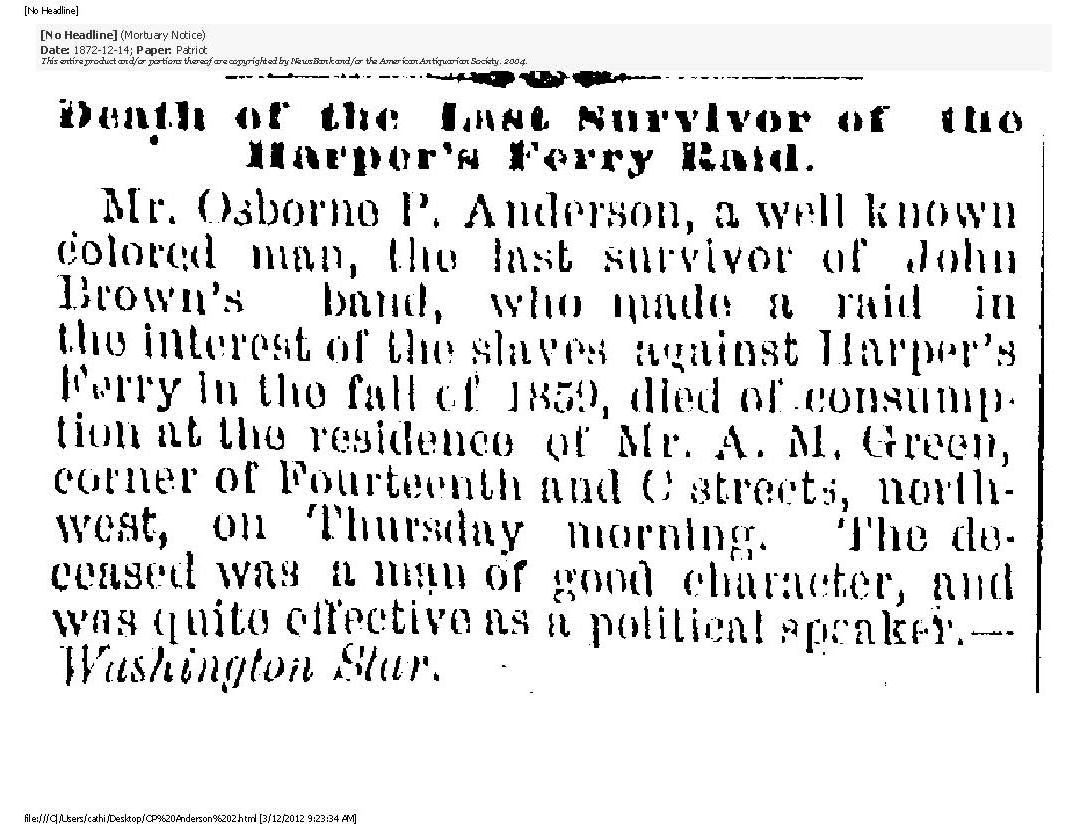
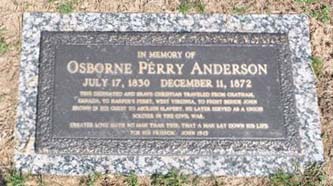
Anderson faced hardships later in life. After surviving John Brown’s raid on Harpers Ferry, he struggled with health issues and financial difficulties. His life after the raid was marked by challenges, and he did not achieve the same level of recognition or financial stability as some of his contemporaries.
Osborne Perry Anderson passed away on December 11, 1872, from consumption, also known as tuberculosis. He was 42 years old. At the time of his death, Anderson was living in a rowhouse on 14th Street NE between B and C Streets in the Capitol Hill neighborhood of Washington, DC. He passed away at the home of a friend, A.M. Green. He is buried in National Harmony Memorial Park Cemetery in Hyattsville, Maryland.
Anderson’s Legacy
After the Harpers Ferry raid, Osborne Perry Anderson continued his fight against slavery. In 1861, he joined the Union Army as a recruitment officer in Indiana and Arkansas, supporting the Union cause during the Civil War. His first-hand account of the raid, A Voice from Harper’s Ferry, provided a unique perspective on the events, the motivations behind them, and the experiences of the raiders.
Anderson’s writings helped to inspire others and advance the abolitionist movement. In his book, he argued that many local enslaved people would have welcomed their liberation and that some had even helped Brown and his men. He also worked with the Chatham Vigilance Committee in Canada, which helped protect escaped slaves from being returned to the U.S. and re-enslaved.
Anderson’s life and work continue to be relevant today in discussions of race, justice, and civil rights. His story highlights the long history of the fight against systemic oppression and shows how individuals like Anderson took bold steps to challenge slavery and fight for freedom. His writings and activism helped inspire future generations and remain an important part of the ongoing struggle for equality and human rights.
Conclusion
Osborne Perry Anderson was a committed abolitionist who spent his life fighting against slavery. Born free in Pennsylvania to Vincent and Sophia Taylor Anderson, he went to Oberlin College and later got involved in the abolitionist movement in Canada.
Anderson played an important role in John Brown’s raid on Harpers Ferry. He served as the recording secretary, was part of Brown’s provisional congress, and took on tasks like guarding prisoners and negotiating with hostages. His courage was clear during the raid, especially when he helped distribute weapons to enslaved people and faced danger directly.
After the raid failed and Brown was captured, Anderson managed to escape to Pennsylvania with help from supporters like William C. Goodridge. He later made his way to Canada and continued his fight against slavery, even joining the Union Army during the Civil War. His account of the raid, A Voice from Harper’s Ferry, offered a unique view of the events and the reasons behind them.
Anderson died of tuberculosis in 1872, but his work and bravery live on. He never married or had children, but his legacy is remembered through his writings and his role in the abolitionist movement. His story shows the determination and courage of those who fought for freedom and justice.
“The wrath of the people must be just and the sword must be sharpened; the time for talking is past; the spirit of the dead must be avenged.” — Osborne Perry Anderson
Frequently asked questions about Osborne Perry Anderson
- Who was Osborne Perry Anderson? Osborne Perry Anderson was a Black American abolitionist and the only surviving member of John Brown’s raid on Harpers Ferry in 1859.
- What was John Brown’s raid about? John Brown’s raid on Harpers Ferry, which took place from October 16 to 18, 1859, was an attempt by the abolitionist John Brown and his followers to initiate a slave revolt by seizing the United States arsenal at Harpers Ferry, Virginia (now West Virginia). Brown aimed to arm enslaved people and create a stronghold for them in the mountains. The raid ultimately failed, and Brown was captured and later executed for treason.
- When and where was Osborne Perry Anderson born? Anderson was born on July 27, 1830, in West Fallowfield Township, Chester County, Pennsylvania.
- What role did Osborne Perry Anderson play in John Brown’s raid on Harpers Ferry? Anderson was one of the five Black American men who accompanied John Brown during the raid. He served as the recording secretary and helped with the planning and execution of the raid.
- How did Osborne Perry Anderson escape capture after the raid? Anderson was the only member of Brown’s party to escape capture when U.S. Marines attacked the arsenal. He fled to Pennsylvania and later wrote an account of the raid.
- What did Osborne Perry Anderson do after the raid on Harpers Ferry? After the raid, Anderson enlisted in the Union Army during the Civil War and served as a recruitment officer. He also wrote a book, “A Voice from Harper’s Ferry,” detailing his experiences during the raid.
- Why is Anderson’s story significant? Osborne Perry Anderson’s story is significant because he was the only Black American survivor of John Brown’s raid on Harpers Ferry, and his account, “A Voice from Harper’s Ferry,” provided a unique perspective on the raid. His survival and writings offered invaluable insights into the motivations and experiences of the raiders, furthering the abolitionist cause and inspiring future generations. His contributions highlight the courage and determination required to fight for justice and equality.
- When and where did Osborne Perry Anderson die? Anderson passed away on December 11, 1872, in Washington, D.C.
Sources
- Anderson, Osborne Perry. A Voice from Harper’s Ferry: A Narrative of Events at Harper’s Ferry: with Incidents Prior and Subsequent to Its Capture by Captain Brown and His Men. United States: author, 1861. (Google Books)
- Douglass, F. (1845). Narrative of the Life of Frederick Douglass, an American Slave. Boston: Anti-Slavery Office. (Google Books)
- Earle, Jonathan. John Brown’s Raid on Harpers Ferry: A Brief History with Documents. United States: Bedford/St. Martin’s, 2018.
- Ripley, C. Peter, ed. The Black Abolitionist Papers. Chapel Hill: University of North Carolina Press, 1985. (Internet Archive)
- Glasgow, J. Ewing., Brown, John. The Harper’s Ferry Insurrection: Being an Account of the Late Outbreak in Virginia, and of the Trial and Execution of Captain John Brown, Its Hero. United Kingdom: n.p., 1860. (Google Books)
- Library Television Network. 2020. “History Alive ‘Osborne Perry Anderson.’” https://www.youtube.com/watch?v=MfMAkcnmVBI.
- Wikipedia contributors. 2024. “Osborne Perry Anderson.” Wikipedia. July 15, 2024. https://en.wikipedia.org/wiki/Osborne_Perry_Anderson.
- Wikipedia contributors. 2024. “John Brown’s Raid on Harpers Ferry.” Wikipedia. December 26, 2024. https://en.wikipedia.org/wiki/John_Brown%27s_raid_on_Harpers_Ferry.
- Wikipedia contributors. 2024. “Virginia V. John Brown.” Wikipedia. December 4, 2024. https://en.wikipedia.org/wiki/Virginia_v._John_Brown.
- The Editors of Encyclopaedia Britannica. 2024. “Harpers Ferry Raid | Date, Significance, John Brown, & Facts.” Encyclopedia Britannica. November 11, 2024. https://www.britannica.com/event/Harpers-Ferry-Raid.
- Onion, Amanda. 2023. “John Brown’s Harpers Ferry.” HISTORY, August 21, 2023. https://www.history.com/topics/slavery/harpers-ferry.
- Mullen, Matt. 2023. “John Brown: Abolitionist, Raid & Harpers Ferry – HISTORY.” HISTORY, June 27, 2023. https://www.history.com/topics/slavery/john-brown.
- Westbrook, Ariana. 2024. “Osborne P. Anderson (1830-1872) •” July 11, 2024. https://www.blackpast.org/african-american-history/anderson-osborne-p-1830-1872/.
- “Blog • the Anderson Family in Chester County.” 2021. https://www.chesco.org/Blog.aspx?IID=18.
- “Osborne Perry Anderson (1830-1872) | WikiTree FREE Family Tree.” 1830. July 27, 1830. https://www.wikitree.com/wiki/Anderson-72328.
- “John Brown Execution Eyewitness – VMI Archives – Virginia Military Institute.” n.d. https://www.vmi.edu/archives/manuscripts/stonewall-jackson-resources/john-brown-execution-eyewitness/.
- “John Brown Chapter Twelve.” n.d. https://archive.wvculture.org/history/jbexhibit/jbchapter12.html.
- Mingus, Scott. 2020. “Civil War Voices: Osborne Perry Anderson, Harpers Ferry Raider – Cannonball.” Cannonball. October 26, 2020. https://yorkblog.com/cannonball/civil-war-voices-osborne-perry/.
- “The Trial of John Brown: The Report of the 1859 Trial, Including Speeches and Testimony.” n.d. http://law2.umkc.edu/faculty/projects/ftrials/johnbrown/browntrial.html.
- “John Brown’s Raiders.” 2009. American Battlefield Trust. https://www.battlefields.org/learn/articles/john-browns-raiders.
- Bodego, Joe. 2023. “Osborne Perry Anderson.” SamePassage (blog). July 7, 2023. https://samepassage.org/osborne-perry-anderson/.
- “ExplorePAHistory.com – Image.” n.d. https://explorepahistory.com/displayimage.php?imgId=1-2-205E.
- “At The Chatham Convention in Ontario, John Brown Sets up His Provisional Constitution | House Divided.” 1858. May 8, 1858. https://hd.housedivided.dickinson.edu/node/29341.
- Tsai, Robert L. n.d. “John Brown’s Constitution”. University of Maryland School of Law. n.d. https://digitalcommons.law.umaryland.edu/cgi/viewcontent.cgi?referer=&httpsredir=1&article=1084&context=schmooze_papers.
- Dixon, Mark E. 2024. “The Surprising Role One Local Man Played in the Deadly Harpers Ferry Raid.” Main Line Today. January 7, 2024. https://mainlinetoday.com/life-style/the-surprising-role-one-local-man-played-in-the-deadly-harpers-ferry-raid/.
- “The Liberator (Boston, Mass.), October 28, 1859.” 1859. The Library of Congress. October 28, 1859. https://www.loc.gov/resource/sn84031524/1859-10-28/ed-1/?st=gallery.
- Find a Grave, database and images (https://www.findagrave.com/memorial/46533175/osborne_perry-anderson: accessed October 22, 2024), memorial page for Osborne Perry Anderson (17 Jul 1830–11 Dec 1872), Find a Grave Memorial ID 46533175, citing National Harmony Memorial Park Cemetery, Hyattsville, Prince George’s County, Maryland, USA; Maintained by Chatham-Kent Black Historical Society (contributor 49923176).
© 2026 Chandra Martin. All Rights Reserved.
All original research, writing, analysis, and historical synthesis on this site is the intellectual property of Chandra Martin. This content may not be copied, reproduced, republished, distributed, adapted, or used in any form—digital or print—without prior written permission from the author.
Limited quotation for academic or educational purposes is permitted only if proper credit is given and the use does not alter the meaning, context, or integrity of the work.
To request permission for use in publications, videos, courses, educational materials, or digital media, please
contact:
Contact
Include:
- Your name
- The specific content you wish to use
- How and where it will be used
- Whether the use is commercial or non-commercial
All requests will be reviewed on a case-by-case basis.
 Chandra Martin
