

Paul Revere Williams was a Black American architect who designed over 3,000 buildings, including homes for Hollywood stars like Frank Sinatra and Lucille Ball. As the first Black American member of the American Institute of Architects, his work shaped Los Angeles’s architectural landscape.
Table of Contents
- Introduction
- Early Life and Education
- Architectural Achievements
- Marriage and Children
- Recognition and Legacy
- Death
- Impact on Diversity in Architecture
- Conclusion
- FAQs
- Sources
Introduction
Paul Revere Williams was a remarkable architect whose work left a significant impact on the architectural landscape of Los Angeles and beyond. Born in 1894, he overcame racial barriers to become the first Black American member of the American Institute of Architects. Williams designed over 3,000 buildings, including homes for Hollywood stars like Frank Sinatra and Lucille Ball. His innovative designs and commitment to excellence earned him the nickname “architect to the stars.”
Early Life and Education
Paul Revere Williams was born on February 18, 1894, in Los Angeles, California. His parents, Chester Stanley and Lila Wright Williams, moved to Los Angeles from Memphis, Tennessee, in 1893 to start a fruit business, but it wasn’t successful. His father passed away in 1896 from tuberculosis, and his mother died two years later from the same illness. Paul and his older brother, Charles Stanley Williams, Jr were left as orphans. Both brothers were placed in separate foster homes until they were eventually adopted by C.I. Clarkson and his wife, Emily P. Clarkson.
The Clarkson family provided a supportive and nurturing environment for the boys. Emily, in particular, played a significant role in encouraging Paul’s interest in art and drawing. This support shaped Paul’s future career as an architect. The Clarkson family’s encouragement helped Paul overcome the challenges he faced as an orphan and as one of the few Black American students in his school.
Paul Revere Williams attended Polytechnic High School in Los Angeles. As the only Black student there, he faced racial discrimination and was counseled against pursuing architecture. He was advised to pursue a career as a doctor or lawyer, as his counselor believed those professions would be more suitable for Black Americans at the time. Fortunately, Williams was not deterred by the advice. He excelled in his studies and graduated from high school in 1912.
After high school, Williams pursued his interest in architecture and took classes in architecture and design at the Los Angeles Beaux-Arts School and later attended the University of Southern California, where he studied architectural engineering from 1916 to 1919. During this time, he worked as a landscape architect and gained practical experience by designing several residential buildings. Williams became a certified architect in California in 1921, making him the first Black American architect west of the Mississippi.
Architectural Achievements

Paul Revere Williams had a remarkable career with numerous architectural achievements. He designed homes for many celebrities, including Frank Sinatra, Lucille Ball, Desi Arnaz, and Barbara Stanwyck. His talent wasn’t just limited to residential projects; he also worked on significant public buildings like the Los Angeles Superior Courthouse, the Theme Building at Los Angeles International Airport (LAX), and the First AME Church in Los Angeles.
Paul Revere Williams also contributed to commercial projects, such as the Saks Fifth Avenue store in Beverly Hills and the Golden State Mutual Life Insurance Building. He designed numerous residential buildings, including the Pueblo del Rio Housing Development and the Imperial Courts Housing Development in Los Angeles. Williams played a vital role in public housing projects during World War II and designed landmark buildings for black-owned businesses in Los Angeles. His work is celebrated for its elegance and versatility, and has left its mark on the architectural landscape of Southern California.
Despite his successes, Williams still had to deal with the racial challenges of the time. He developed unique strategies to navigate through discrimination and prejudice. He developed the unique ability to sketch his designs upside down as a way to make his clients more comfortable during meetings. It is highly likely that the racial climate would cause some of his clients to feel uneasy sitting next to a Black American architect. By sketching upside down, Williams could sit across the table from his clients, allowing them to view the drawings right-side-up as he worked. This not only made it easier for clients to visualize his designs but also avoided any potential discomfort or awkwardness they might have felt.
In addition to sketching upside down, Williams also kept his hands clasped behind his back when meeting clients. This gesture was his way of avoiding any awkwardness or potential discomfort that might arise from shaking hands with a Black man. This act helped to put his clients at ease and allowed him to focus on the professional aspects of his interactions, and build a highly successful career.
Marriage and Children
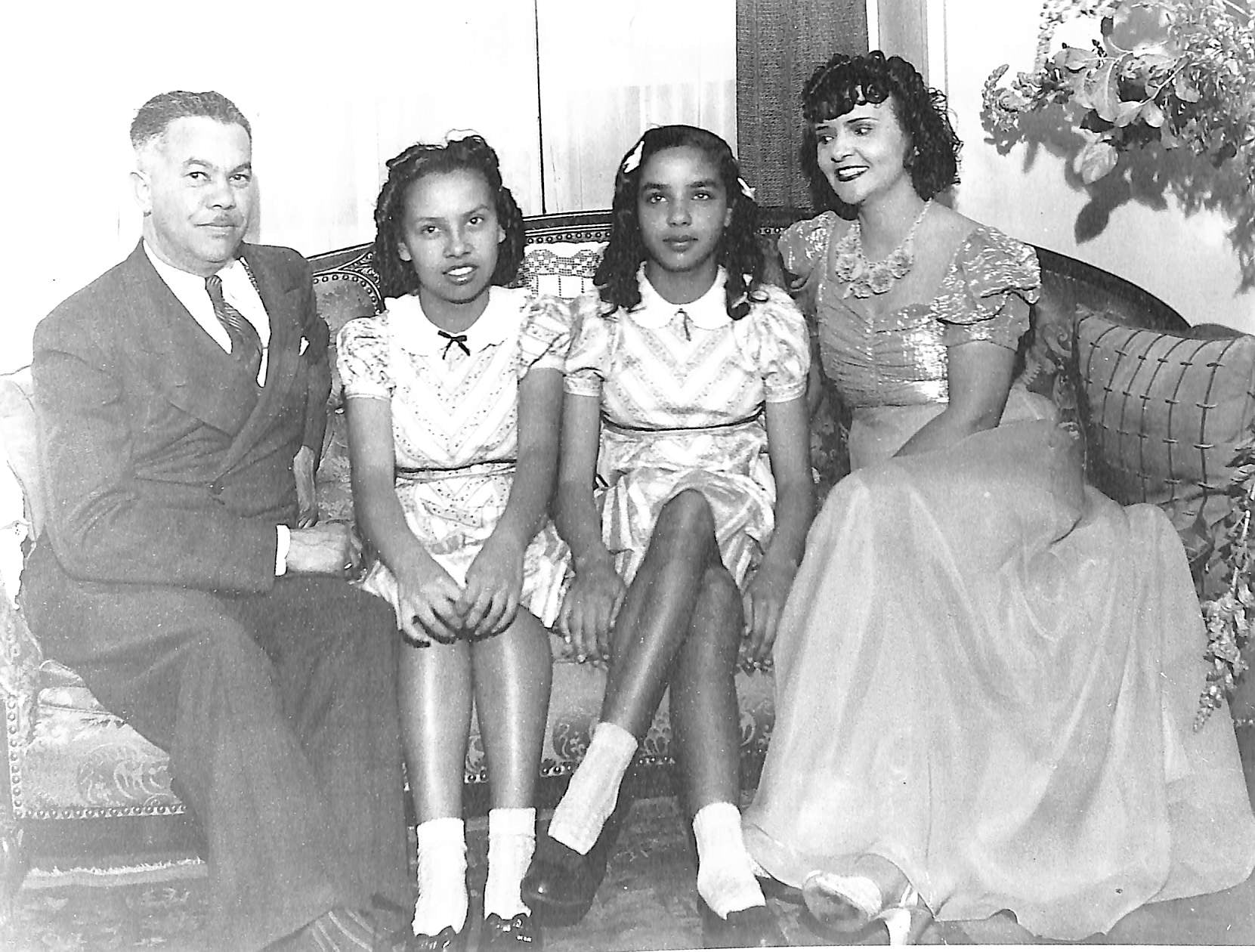
Paul Revere Williams met Della Mae Givens through mutual acquaintances in the Los Angeles community. They got to know each other and eventually fell in love. They married on June 27, 1917, at the First AME Church in Los Angeles, which Williams would later design a new location for.
Della Mae Givens Williams was a community leader and philanthropist. She co-founded the Wilfandel Club, an organization dedicated to community service and cultural enrichment for Black American women. Della Mae was also involved with the Assistance League of the Stovall Foundation, which focused on outdoor life and health initiatives.
They had three children together: Paul Revere Williams Jr., Marilyn Frances Williams, and Norma Lucille Williams Harvey. Sadly, Paul Revere Williams Jr. lived for just a few hours after his birth. Their marriage lasted until Williams’ death in 1980.
“If I allow the fact that I am a Negro to checkmate my will to do, now, I will inevitably form the habit of being defeated.” – Paul Revere Williams
Recognition and Legacy

Paul Revere Williams received several recognitions throughout his career:
- First African American Fellow of the American Institute of Architects (AIA): In 1957, Williams became the first African American to be elected a Fellow of the AIA, a prestigious honor recognizing his contributions to the field of architecture.
- AIA Gold Medal: In 2017, Williams was posthumously awarded the AIA Gold Medal, making him the first African American architect to receive this prestigious award. This award acknowledged his outstanding achievements and a career that broke racial barriers.
- First African American President of the Los Angeles Chapter of the AIA: Williams also served as the first Black American president of the Los Angeles chapter of the AIA, further highlighting his leadership and impact on the architectural community.
His archive, which documents his entire career, is now jointly held by the USC School of Architecture and the Getty Research Institute, making his work accessible to students and researchers. Williams’s legacy is celebrated for his contributions to the cultural landscape and design of Los Angeles, as well as his overcoming racial inequities in his professional life.
Death

Paul Revere Williams suffered from diabetes in his later years. On January 23, 1980, in his Los Angeles home, he died of complications from the disease. He is interred in a mausoleum at Inglewood Park Cemetery in Los Angeles. His resting place is in the Sanctuary of Radiance, Manchester Garden Mausoleum.
Impact on Diversity in Architecture
Paul Revere Williams had a profound impact on diversity in architecture by breaking racial barriers and serving as a role model for future generations of architects, especially Black Americans. As the first Black American member, Fellow, and Gold Medalist of the American Institute of Architects (AIA), he paved the way for greater inclusion in the field. His success and recognition helped challenge the prevailing prejudices of his time and demonstrated that talent and dedication could overcome racial obstacles.
Williams was also involved in social housing projects and mentored young architects, inspiring them to pursue their dreams despite societal challenges. His legacy continues to inspire architects today, promoting diversity and inclusion in the architectural profession.
Conclusion
Paul Revere Williams was born in Los Angeles in 1894. Orphaned at a young age, he overcame significant adversity to pursue his passion for architecture. He graduated from the University of Southern California (USC) School of Architecture and became the first Black American to become a licensed architect west of the Mississippi.
Williams designed over 3,000 buildings throughout his career, including homes for celebrities like Frank Sinatra and public buildings such as the Theme Building at LAX and the Los Angeles Superior Courthouse. His achievements include becoming the first Black American member, Fellow, and Gold Medalist of the American Institute of Architects (AIA).
His work left a lasting impact on the architectural landscape and continues to inspire future generations. Williams’s legacy is a testament to his talent, determination, and ability to overcome racial barriers, promoting diversity and inclusion in the field of architecture.
Frequently asked questions about Paul Revere Williams
- Who was Paul Revere Williams?
- Paul Revere Williams was a pioneering African American architect known for designing over 3,000 buildings, including homes for celebrities and significant public structures. He was the first African American member, Fellow, and Gold Medalist of the American Institute of Architects (AIA), and his work continues to inspire and promote diversity in the field of architecture.
- What were some of his notable projects?
- Paul Revere Williams designed several notable projects, including the Theme Building at LAX, the Beverly Hills Hotel renovation, and St. Jude Children’s Research Hospital.
- Why is his recognition as a Fellow significant?
- Paul Revere Williams’s recognition as a Fellow of the American Institute of Architects (AIA) is significant because he was the first African American to receive this honor, breaking racial barriers and setting a precedent for future generations of minority architects.
- How did Paul Revere Williams influence future architects?
- Paul Revere Williams influenced future architects by breaking racial barriers and serving as a role model for minority architects. His success and recognition in the field demonstrated that talent and dedication could overcome societal obstacles, inspiring future generations to pursue careers in architecture despite challenges.
- What is the current state of diversity in architecture?
- The current state of diversity in architecture shows progress but still has room for improvement. While there has been an increase in the number of minority and female architects, they are still underrepresented. For example, in 2022, only 3% of architects in the U.S. were Black, and 23.3% were women. Efforts to promote diversity, equity, and inclusion (DEI) are ongoing, with initiatives to make the profession more accessible and inclusive.
Sources
- Cederholm, Theresa Dickason. Afro-American Artists; a Bio-bibliographical Directory. United States: Trustees of the Boston Public Library, 1973. (Internet Archive)
- The Negro Almanac: A Reference Work on the African American. United Kingdom: Gale Research, 1989. (Internet Archive)
- Robinson, Wilhelmena S. Historical Negro Biographies. New York: Publishers Company Inc., 1969. (Internet Archive)
- Hudson, Karen E.., Chan, Benny. Paul R. Williams: Classic Hollywood Style. United Kingdom: Rizzoli, 2012.
- Ireland, Janna. Regarding Paul R. Williams: A Photographer’s View. United States: Angel City Press, 2020.
- Wikipedia contributors. 2024. “Paul R. Williams.” Wikipedia. August 22, 2024. https://en.wikipedia.org/wiki/Paul_R._Williams.
- The Editors of Encyclopaedia Britannica. 2014. “Paul R. Williams | African American Architect & Hollywood Designer.” Encyclopedia Britannica. August 6, 2014. https://www.britannica.com/biography/Paul-R-Williams.
- “Paul Revere Williams Project.” 2022. https://www.paulrwilliamsproject.org/.
- Gallinger, Zack. 2023. “Creating a More Inclusive and Diverse Architecture Industry.” Archipro. October 3, 2023. https://archipro.com/blog/creating-a-more-inclusive-and-diverse-architecture-industry/.
- Florian, Maria-Cristina. 2024. “Advancements in Gender Equity and Racial Diversity in Architecture: 2024 NCARB Numbers Report Findings.” ArchDaily. September 3, 2024. https://www.archdaily.com/1020779/advancements-in-gender-equity-and-racial-diversity-in-architecture-2024-ncarb-numbers-report-findings.
- Teja, Nrk Sudheendra. 2023. “Paul Williams- 15 Iconic Projects.” RTF | Rethinking the Future. May 15, 2023. https://www.re-thinkingthefuture.com/design-studio-portfolios/a3906-paul-williams-15-iconic-projects/.
- Kuttiparambil, Namitha. 2024. “Paul R. Williams: Ideology and Philosophy.” RTF | Rethinking the Future. February 14, 2024. https://www.re-thinkingthefuture.com/know-your-architects/a12089-paul-r-williams-ideology-and-philosophy/.
- Griffin, Chante. 2024. “Seven of Paul Revere Williams’ Outstanding Architectural Feats (That Aren’t Homes).” PBS SoCal. January 8, 2024. https://www.pbssocal.org/shows/hollywoods-architect-the-paul-r-williams-story/seven-of-paul-revere-williams-outstanding-architectural-feats-that-arent-homes.
- “USModernist Archives.” n.d. https://usmodernist.org/pwilliams.htm.
- “Williams, Paul R. 1894–1980 | Encyclopedia.com.” n.d. https://www.encyclopedia.com/education/news-wires-white-papers-and-books/williams-paul-r-1894-1980.
- “A Quiet Gentleman: Paul Revere Williams and His Los Angeles Dream.” 2019. Los Angeles Public Library. https://www.lapl.org/collections-resources/blogs/lapl/quiet-gentleman-paul-revere-williams-and-his-los-angeles-dream.
- Hood, Amy. 2020. “The Legacy of Paul Revere Williams.” Getty Iris. November 2, 2020. https://blogs.getty.edu/iris/the-legacy-of-paul-revere-williams/.
- Lawson, Michael. 2023. “Paul Revere Williams: The Architect Who Helped Shape Los Angeles and Inspired Generations | Los Angeles.” Los Angeles Urban League (blog). February 5, 2023. https://laul.org/paul-revere-williams-the-architect-who-helped-shape-los-angeles-and-inspired-generations/.
- Hawthorne, Christopher. 2017. “Paul Revere Williams: From the Center to the Margins and Back Again.” Architect. April 17, 2017. https://www.architectmagazine.com/awards/aia-awards/paul-revere-williams-from-the-center-to-the-margins-and-back-again_o.
- Howarth, Dan, and Dan Howarth. 2018. “Paul Revere Williams Becomes First Black Architect to Receive AIA Gold Medal.” Dezeen, March 9, 2018. https://www.dezeen.com/2016/12/09/paul-revere-williams-first-black-architect-aia-gold-medal-2017/.
- “Paul Revere Williams (1894-1980) | WikiTree FREE Family Tree.” 1894. February 18, 1894. https://www.wikitree.com/wiki/Williams-71218.
- Leonard, Kevin. 2024. “Paul R. Williams (1894-1980) •” April 7, 2024. https://www.blackpast.org/african-american-history/williams-paul-r-1894-1980/.
- Kelly, Kate. 2024. “Paul R. Williams (1894-1980), Los Angeles-based Architect.” America Comes Alive. October 22, 2024. https://americacomesalive.com/paul-r-williams-1894-1980-los-angeles-based-architect/.
- “Paul Revere Williams – Perot Museum.” 2022. Perot Museum. February 8, 2022. https://www.perotmuseum.org/events/children-and-families/STEMLeaders/paul-revere-williams/.
- Brame, Karen D. 2021. “Paul R. Williams.” BlacklistedCulture.Com. June 29, 2021. https://blacklistedculture.com/paul-r-williams/.
- Find a Grave, database and images (https://www.findagrave.com/memorial/7956107/paul_revere-williams: accessed December 24, 2024), memorial page for Paul Revere Williams (18 Feb 1894–23 Jan 1980), Find a Grave Memorial ID 7956107, citing Inglewood Park Cemetery, Inglewood, Los Angeles County, California, USA; Maintained by Find a Grave.
- Find a Grave, database and images (https://www.findagrave.com/memorial/7974428/della_mae-williams: accessed December 24, 2024), memorial page for Della Mae Givens Williams (18 Nov 1895–24 Jul 1996), Find a Grave Memorial ID 7974428, citing Inglewood Park Cemetery, Inglewood, Los Angeles County, California, USA; Maintained by Shiver (contributor 46539565).
- Find a Grave, database and images (https://www.findagrave.com/memorial/9926112/paul_revere-williams: accessed December 24, 2024), memorial page for Paul Revere Williams Jr. (30 Jun 1925–30 Jun 1925), Find a Grave Memorial ID 9926112, citing Evergreen Cemetery, Los Angeles, Los Angeles County, California, USA; Maintained by R Wheaton (contributor 46537246).
© 2026 Chandra Martin. All Rights Reserved.
All original research, writing, analysis, and historical synthesis on this site is the intellectual property of Chandra Martin. This content may not be copied, reproduced, republished, distributed, adapted, or used in any form—digital or print—without prior written permission from the author.
Limited quotation for academic or educational purposes is permitted only if proper credit is given and the use does not alter the meaning, context, or integrity of the work.
To request permission for use in publications, videos, courses, educational materials, or digital media, please
contact:
Contact
Include:
- Your name
- The specific content you wish to use
- How and where it will be used
- Whether the use is commercial or non-commercial
All requests will be reviewed on a case-by-case basis.
 Chandra Martin
