
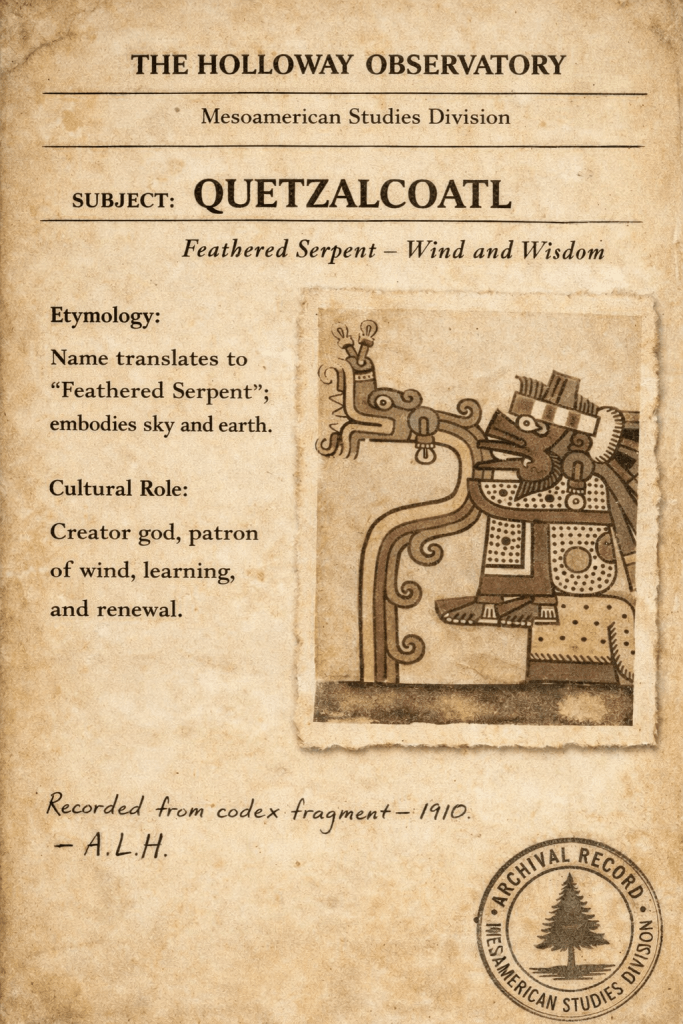
Among the gods of ancient Mesoamerica, Quetzalcoatl—the Feathered Serpent—embodies the union of earth and sky, wisdom and wind. Revered by the Toltec and later the Aztec, his name translates to quetzal (precious bird) and coatl (serpent), a symbol of divine duality: beauty bound to power, spirit bound to matter.
Origins
Quetzalcoatl’s earliest traces appear in Teotihuacan, centuries before the Aztec Empire. His image—serpent body adorned with feathers—was carved into temple walls and painted on pottery, marking him as a god of creation, wind, and learning.
- Etymology: Quetzalcoatl means “Feathered Serpent,” a fusion of celestial grace and terrestrial strength.
- Historical context: Worship spread through Toltec centers such as Tula, where he was honored as a civilizing deity who taught agriculture, writing, and the calendar.
- Aztec adaptation: The Mexica adopted him as the god of wind (Ehecatl) and knowledge, often paired with Tlaloc, the rain god, in rituals of renewal.
Attributes and Symbolism
Quetzalcoatl represents the breath of life—the invisible force that animates creation. He is both serpent and bird, earthbound yet airborne, symbolizing transformation and transcendence.
Associated symbols:
- Feathers: divine lightness and celestial wisdom.
- Serpent: fertility, motion, and the cyclical nature of existence.
- Wind: the unseen messenger between worlds.
- Shell or conch: the sound of creation, used in his rituals.
Mythic Role
In Aztec cosmology, Quetzalcoatl helped create humanity. He descended into the underworld to retrieve the bones of past generations, mixing them with his own blood to form new life. He was also said to have brought maize to humankind and taught the arts of civilization—a god of renewal rather than conquest.
Common beliefs and stories:
- Quetzalcoatl opposed human sacrifice, favoring offerings of flowers and song.
- His departure from the world was marked by prophecy: he would one day return from the east.
- His twin and counterpart, Tezcatlipoca, represented chaos and conflict—the eternal balance of creation and destruction.
Cultural Interpretation
Quetzalcoatl’s mythology reflects the Mesoamerican ideal of harmony—the balance between intellect and nature. He is the civilizing wind, the breath that moves through temples and fields alike. In later centuries, his legend was reshaped by colonial narratives, but his essence remains: a god of knowledge, mercy, and transformation.
Modern Legacy
Today, Quetzalcoatl endures as a symbol of cultural identity and renewal. His image appears in murals, literature, and modern art across Mexico and Central America. To scholars, he represents the continuity of indigenous philosophy—a deity whose wisdom transcends empire and time.
End of Record
A serpent crowned with feathers. A god who gave breath to the world. And a reminder that creation begins with compassion.
References
- Novato, Ernesto., Charles River Editors. Quetzalcoatl: The History and Legacy of the Feathered Serpent God in Mesoamerican Mythology. Independently Published, 2019.
- Nicholson, Henry B.. Topiltzin Quetzalcoatl: The Once and Future Lord of the Toltecs. United States: University Press of Colorado, 2001.
- Wikipedia contributors. 2025. “Quetzalcōātl.” Wikipedia. February 6, 2025. https://en.wikipedia.org/wiki/Quetzalc%C5%8D%C4%81tl.
- Cartwright, Mark, and Marcelosan. 2023. “Quetzalcóatl.” World History Encyclopedia, March. https://www.worldhistory.org/Quetzalcoatl/.
- The Editors of Encyclopaedia Britannica. 2025. “Quetzalcoatl | Definition, Myth, & Meaning.” Encyclopedia Britannica. February 24, 2025. https://www.britannica.com/topic/Quetzalcoatl.
- “Quetzalcoatl – Mythopedia.” 2023. Mythopedia. https://mythopedia.com/topics/quetzalcoatl.
- Admin. 2024. “Quetzalcoatl and Its Legend – Chocante.” Chocante (blog). June 5, 2024. https://chocante.pl/en/quetzalcoatl-and-its-legend/.
- “Learn Spanish in Cuernavaca Mexico at UNINTER.” n.d. Spanish Language Institute. https://spanishschool.uninter.edu.mx/Anniversary/Mexican-Culture/Legend-of-Quetzalcoatl.
- “The Feathered Serpent, Quetzalcoatl | Role, Legends & Beliefs – Video | Study.com.” n.d. study.com. https://study.com/academy/lesson/video/quetzalcoatl-legend-lesson-quiz.html.
- Maestri, Nicoletta. 2019. “Quetzalcoatl – Pan-Mesoamerican Feathered Serpent God.” ThoughtCo. April 3, 2019. https://www.thoughtco.com/quetzalcoatl-feathered-serpent-god-169342.
© 2026 Chandra Martin. All Rights Reserved.
All original research, writing, analysis, and historical synthesis on this site is the intellectual property of Chandra Martin. This content may not be copied, reproduced, republished, distributed, adapted, or used in any form—digital or print—without prior written permission from the author.
Limited quotation for academic or educational purposes is permitted only if proper credit is given and the use does not alter the meaning, context, or integrity of the work.
To request permission for use in publications, videos, courses, educational materials, or digital media, please
contact:
Contact
Include:
- Your name
- The specific content you wish to use
- How and where it will be used
- Whether the use is commercial or non-commercial
All requests will be reviewed on a case-by-case basis.
Make a one-time donation
Make a monthly donation
Make a yearly donation
Choose an amount
Or enter a custom amount
Your contribution is appreciated.
Your contribution is appreciated.
Your contribution is appreciated.
 Chandra Martin