

Picture yourself meandering through a lively market in old Japan, the air filled with the aroma of fresh goods and the sounds of bargaining. In the midst of the throng, a tall, slim woman draws your attention. It’s not her elegance that stands out, but the extraordinary length of her arms. When she lifts her sleeves, the sight is startling: her arms are adorned with countless, peculiar bird-like eyes. She is known as the Dodomeki, an enigmatic and ominous presence.
The Dodomeki, a figure from Japanese folklore, serves as a stark warning against greed and its transformative power. Originally a human prone to theft, she was transformed into a monstrous form as retribution for her misdeeds. The multitude of eyes that cover her body represent the copper coins she so desperately desired, now a haunting symbol of the price of her avarice.
- The Origins of the Dodomeki
- The Legend of the Dodomeki
- The Symbolism Behind the Dodomeki
- The Dodomeki in Pop Culture
- FAQs
- Sources
The Origins of the Dodomeki
The Dodomeki was first introduced in “Konjaku Gazu Zoku Hyakki” by the 18th-century Japanese artist and scholar, Toriyama Sekien. He brought various yōkai, or supernatural creatures, to life in his illustrated collections. Sekien’s contributions were significant in making many yōkai widely known, the Dodomeki being one of them.
The story of the Dodomeki serves as a moral lesson. Legend has it that the Dodomeki was once a young woman whose intense longing for riches drove her to steal. Her continuous thievery brought upon her a curse, causing bird-like eyes to sprout across her arms, representing the coins she so desperately desired. This served as a tangible sign of her avarice and deceit. Eventually, the curse turned her into a yōkai, a supernatural creature, as retribution for her misdeeds, setting her as a warning in folklore.
The term “Dodomeki” cleverly combines two concepts. In Japanese, “long arms” is a metaphor for a thief, and “dōsen” alludes to ancient copper coins with designs similar to bird’s eyes. Therefore, both the name and form of this creature are emblematic of its propensity for theft.
“The eyes are the mirror of the soul and reflect everything that seems to be hidden; and like a mirror, they also reflect the person looking into them.” – Paulo Coelho
The Legend of the Dodomeki
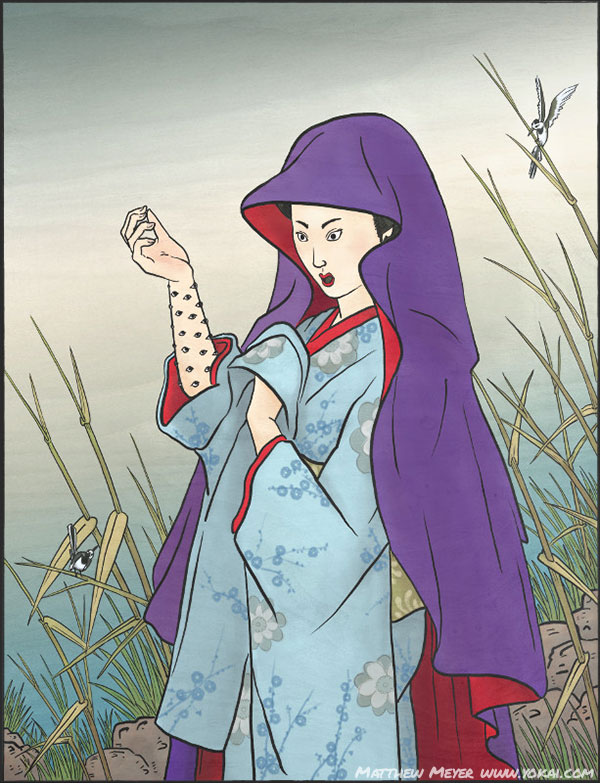
In ancient Japan, a young woman was famed for her beauty and allure. Yet, her name was tainted by a scandalous penchant for thievery. With slender fingers, she’d deftly pilfer coins from unsuspecting victims, driven by an insatiable thirst for opulence and splendor.
A woman once committed a sacred theft from a shrine, provoking the wrath of the gods. In response to her unabashed avarice, a curse was placed upon her. Gradually, she observed transformations within herself; her arms elongated and tiny eyes sprouted across them, each one representing the copper coins she had taken.
The change was terrifying and filled her with remorse. She sought to conceal her looks and live a life of solitude, yet the curse persisted in tormenting her. Her formerly graceful arms were now laden with countless eyes, ever observant, a relentless reminder of her previous misdeeds.
Cursed, she wandered the lands, a restless spirit. Her very presence sowed seeds of dread among those who crossed her path. The tale of the Dodomeki served as a stark warning against avarice, underscoring the value of integrity in one’s life.
Encountering this yōkai would likely instill fear and discomfort, as her presence is quite unsettling. The Dodomeki may challenge a person, particularly if they exhibit dishonest or greedy traits. Such an encounter could act as a caution or a sign of impending misfortune should they persist in their deceitful behavior.
The Symbolism Behind the Dodomeki
The Dodomeki, with its haunting visage and the tale that accompanies it, stands as a stark warning against the perils of avarice and the importance of integrity. Once a human woman notorious for pilfering coins, her metamorphosis into a yōkai adorned with avian eyes upon her limbs is a tangible representation of her covetous nature. This change, born from her acts of thievery, represents the way greed can mar and distort the soul.
The eyes adorning the Dodomeki’s arms symbolize the copper coins she pilfered. “Dōsen” in Japanese means ancient copper coins, akin to the eyes of birds. Therefore, her arms, blanketed with eyes, stand as an enduring testament to her transgressions and the curse they brought upon her. The idiom “long arms” in Japanese culture signifies a propensity for theft, which the Dodomeki’s elongated limbs highlight, underscoring her kleptomaniac tendencies and relentless greed.
In Japanese folklore, the transformation of a person into a yōkai as punishment is a recurring motif. This reflects the idea that supernatural entities can step in to address or penalize wrongdoings, thus upholding social values and moral standards. The tale of the Dodomeki, for instance, is a warning story that underscores the significance of living truthfully and with integrity. It acts as a deterrent against dishonesty by showcasing the harsh repercussions that can follow such conduct.
The Dodomeki in Pop Culture
The Dodomeki, with its eerie and supernatural allure, has been featured in various facets of popular culture. Some of the most prominent examples include:
- Shin Megami Tensei Franchise: In these games, the Dodomeki retains its signature long arms adorned with numerous bird eyes, a direct nod to traditional Japanese folklore. The Shin Megami Tensei series is renowned for weaving mythological and supernatural beings into its world, making it the perfect setting for the Dodomeki’s unsettling and distinctive design.
- Yo-Kai Watch Franchise: The Dodomeki is reimagined as Eyesoar, taking on a more kid-friendly appearance. In this version, Eyesoar is a black, humanoid creature with 13 eyes and horns, offering a unique look while still retaining elements inspired by the original yōkai. This adaptation makes the Dodomeki more accessible to younger audiences, all while preserving the eerie essence of the traditional folklore.
- Warriors Orochi 3 and 4: In these action-packed games, she demonstrates her supernatural powers and striking appearance, featuring her signature long arms covered in numerous bird eyes. The series is renowned for its diverse roster, drawing from various mythologies and historical periods, allowing players to explore the rich lore and unique abilities of these characters in an immersive and dynamic experience.
- Re:Monster: One of the hobgoblin members of the monster clan evolves into a Dodomeki, symbolizing the character’s growth and the series’ inventive use of various yōkai and mythological elements. Re:Monster is celebrated for its intricate and imaginative approach to character evolution, with the Dodomeki’s transformation adding an intriguing layer to the story.
- Ben 10 Series: Eye Guy, the alien with long arms covered in eyes, is inspired by the Japanese folklore creature known as the Dodomeki. His design and abilities are a modern twist on this eerie, supernatural being, blending elements of traditional myth with a fun, kid-friendly appeal.
- Hanako: In Chilla’s Art’s game, the Dodomeki character maintains her unsettling appearance and supernatural qualities, enhancing the horror and suspense throughout the gameplay. Hanako is renowned for its realistic Japanese school setting and intense survival horror elements, providing the perfect backdrop for the Dodomeki’s terrifying presence.
- Onmyoji Franchise: The Dodomeki (called Doumeki in the Japanese version) appears as a summonable shikigami in the series. She retains her supernatural aura, with her signature long arms covered in bird-like eyes. As a shikigami, Doumeki aids players in battles with her distinct abilities and powers, embodying the eerie mystique of her folklore origins.
Its portrayal across literature, manga, films, and other media continues to captivate audiences with its haunting allure.
Frequently asked questions about the Dodomeki
- What does the Dodomeki look like? The Dodomeki is depicted as a tall, slender woman with elongated arms covered in numerous bird-like eyes, symbolizing the coins she once stole.
- Is the Dodomeki a benevolent spirit? The Dodomeki is not regarded as a benevolent spirit; rather, she is a cursed yōkai in Japanese folklore, embodying the consequences of greed and theft.
- What happens if you cross paths with the Dodomeki? Encountering the Dodomeki can be a frightening experience due to her grotesque appearance. Her long arms, covered in countless bird-like eyes, are meant to evoke fear and serve as a vivid reminder of the consequences of greed and dishonesty. Although there are no specific tales of harm resulting from meeting the Dodomeki, her presence usually acts as a supernatural warning against immoral behavior.
- Can the Dodomeki be appeased? In folklore, there is no particular way to appease the Dodomeki. Her tale functions more as a moral lesson on the repercussions of greed and theft than a story of appeasement.
Sources
- Sekien, Toriyama. Japandemonium Illustrated: The Yokai Encyclopedias of Toriyama Sekien. United States: Dover Publications, 2016.
- Meyer, Matthew. The Night Parade of One Hundred Demons: A Field Guide to Japanese Yokai. United States: Matthew Meyer, 2012.
- Yoda, Hiroko., Alt, Matt. Yokai Attack! The Japanese Monster Survival Guide. Japan: Tuttle Publishing, 2013.
- Matt. 2023. “Dodomeki | Yokai.com.” Yokai.Com. January 9, 2023. https://yokai.com/dodomeki/.
- Nair, Nitten. 2024. “Dodomeki : The 100 Eyed Woman.” Mythlok. July 17, 2024. https://mythlok.com/dodomeki/.
- Creature. 2024. “Dodomeki: Japanese Mythical Entity of Greed and Vengeance.” Mythical Creatures – Mythical Beasts Unveiled. February 9, 2024. https://mythical-creatures.com/glossary/japanese/dodomeki/.
- Wiki, Contributors to Mimic. n.d. “Jealousy’s Book/Chapter III.” The Mimic Wiki. https://mimic.fandom.com/wiki/Jealousy%27s_Book/Chapter_III.
- Wiki, Contributors to Chilla’s Art. n.d. “Hanako.” Chilla’s Art Wiki. https://chillas-art.fandom.com/wiki/Hanako.
- Wikipedia contributors. 2024. “Dodomeki.” Wikipedia. October 11, 2024. https://en.wikipedia.org/wiki/Dodomeki.
- FFXIclopedia, Contributors To. n.d. “Dodomeki.” FFXIclopedia. https://ffxiclopedia.fandom.com/wiki/Dodomeki.
© 2026 Chandra Martin. All Rights Reserved.
All original research, writing, analysis, and historical synthesis on this site is the intellectual property of Chandra Martin. This content may not be copied, reproduced, republished, distributed, adapted, or used in any form—digital or print—without prior written permission from the author.
Limited quotation for academic or educational purposes is permitted only if proper credit is given and the use does not alter the meaning, context, or integrity of the work.
To request permission for use in publications, videos, courses, educational materials, or digital media, please
contact:
Contact
Include:
- Your name
- The specific content you wish to use
- How and where it will be used
- Whether the use is commercial or non-commercial
All requests will be reviewed on a case-by-case basis.
 Chandra Martin