
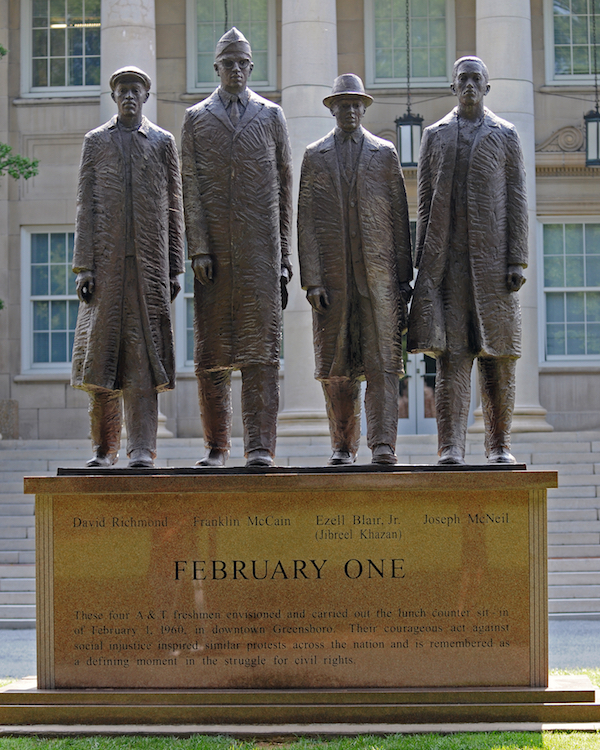
February One is a monument erected in 2002 to commemorate the actions of four Black American college students from North Carolina A&T State University – Ezell Blair Jr. (now Jibreel Khazan), Franklin McCain, Joseph McNeil, and David Richmond, collectively known as the Greensboro Four. The Greensboro Four sat down at a segregated lunch counter at the F. W. Woolworth store on February 1, 1960.
Table of Contents
- Introduction
- The February One Monument: A Brief Overview
- The Greensboro Sit-Ins: A Turning Point
- The Importance of Commemoration
- Community Engagement and Reflection
- Conclusion
- FAQs
- Sources
Introduction
The February One Monument, also known as the A&T Four Monument, is a bronze statue on the campus of North Carolina A&T State University in Greensboro, North Carolina. It honors the Greensboro Four—David Richmond, Franklin McCain, Ezell Blair Jr. (Jibreel Khazan), and Joseph McNeil—who held a sit-in at the F.W. Woolworth store on February 1, 1960, to protest racial segregation.
The monument, created by artist James Barnhill, was dedicated on February 1, 2002, marking the 42nd anniversary of the sit-in. Standing over 15 feet tall, it honors their bravery and the impact of their actions, which sparked similar protests across the country and played a key role in the Civil Rights Movement.
The Greensboro sit-ins were inspired by nonviolent protest methods and the murder of Emmett Till in 1955. The sit-ins led to the desegregation of Woolworth’s lunch counters and helped push forward the fight for racial equality.
The February One Monument: A Brief Overview
The February One Monument, or A&T Four Monument, is a bronze and marble sculpture at North Carolina A&T State University in Greensboro, North Carolina. Created by artist James Barnhill, the monument stands over 15 feet tall and shows the four men—David Richmond, Franklin McCain, Ezell Blair Jr. (Jibreel Khazan), and Joseph McNeil. It is based on the photograph of the four students leaving the Woolworth store after their sit-in on February 1, 1960. It was officially dedicated on February 1, 2002, the 42nd anniversary of the Greensboro sit-ins.
Located in front of the Dudley Building, on the western edge of the campus of North Carolina A&T State University, the monument honors the Greensboro Four and their role in the Civil Rights Movement. Their sit-in at a segregated lunch counter sparked national attention and inspired similar protests, helping drive the movement forward. The inscription reads:
“These four A&T Freshman envisioned and carried out the lunch counter sit-in of February 1, 1960, in downtown Greensboro.”
The Greensboro Sit-Ins: A Turning Point
Overview of the events of February 1, 1960
The Individuals Involved

The individuals involved in the historic Greensboro sit-ins, known as the Greensboro Four were:
- Ezell Blair Jr. (Jibreel Khazan): He was a freshman at North Carolina A&T State University. After the sit-ins, he continued to be active in the Civil Rights Movement and later changed his name to Jibreel Khazan.
- David Richmond: Another freshman at North Carolina A&T, Richmond remained committed to civil rights throughout his life. He worked in various roles in human services and social work.
- Franklin McCain: Also a freshman at the university, McCain became a notable figure in the Civil Rights Movement. He continued to advocate for social justice and worked in the chemical industry.
- Joseph McNeil: The fourth freshman, McNeil, went on to serve in the U.S. Air Force and later worked with the Federal Aviation Administration. He remained involved in civil rights advocacy throughout his career.
The Initial Sit-In at Woolworth’s and Reactions from the Community
The Woolworth’s lunch counter in Greensboro, North Carolina was segregated. Black patrons were only allowed to order take-out food. Inspired by the success of the Montgomery Bus Boycott, and the involvement of the NAACP, young Black Americans began to take direct action against segregation.
On February 1, 1960, the Greensboro Four went into Woolworth’s, bought a few small items to show they were legitimate customers, and sat at the “whites-only” lunch counter. They politely asked for service, but the staff refused because of segregation rules. The Four stayed seated, and the store manager called the police. The police arrived but found no reason to arrest them, so the students were allowed to stay.
The media covered the protest, and the next day, more students joined in. By February 5, around 300 students were protesting at the Woolworth lunch counter. Despite facing harassment like spitting, verbal abuse, and physical attacks from white patrons, the protesters remained peaceful.
While some supported them, others viewed it as disruptive. The sit-ins led to the desegregation of Woolworth’s lunch counter, a key moment in the fight against segregation.
Sparking a National Movement for Civil Rights
The Greensboro sit-ins showed how nonviolent protest could drive change. Their sit-in at Woolworth’s segregated lunch counter got national media attention and spread the message across the country.
Inspired by their actions, similar sit-ins popped up in cities throughout the South, leading to the desegregation of many public spaces. These protests motivated young people and helped create groups like the Student Nonviolent Coordinating Committee (SNCC), which became key in the Civil Rights Movement.
Importance of Commemoration
Importance of Monuments like February One
Monuments like February One help us remember important moments and people in history. They give us a place to reflect, honor, and learn about the past. By keeping these stories alive, monuments remind us of the sacrifices made for justice and equality, ensuring future generations don’t forget their impact.
Role of Memorials in Educating Future Generations
Memorials help teach future generations about the past. They make history relatable with plaques, statues, and exhibits that tell the stories of key events and people. Memorials like the February One Monument show the struggles and achievements that shaped our world. They connect history to the present and teach lessons about bravery, resilience, and justice.
Emotional and Cultural Significance
For the Black American community and others, monuments like the February One Monument hold deep meaning. They honor the courage of those who fought against oppression and discrimination, symbolizing resistance and hope. These monuments recognize the experiences and contributions of African Americans, fostering pride and identity. They also encourage a wider understanding and appreciation of American history.
By remembering the Greensboro Four—Ezell Blair Jr. (Jibreel Khazan), Franklin McCain, Joseph McNeil, and David Richmond—the monument highlights their role in the Civil Rights Movement and inspires future generations to keep working for justice and equality. It reminds us of the progress made and the ongoing effort needed to build an inclusive society.
Community Engagement and Reflection
The local community holds the February One Monument in high regard. Located on the campus of North Carolina A&T State University, it is one of the most photographed spots on campus. The monument honors the bravery of the Greensboro Four and reminds students and visitors of the impact of the sit-in movement.
Each year, the university hosts events to honor the legacy of the Greensboro Four. These include the Sit-In Anniversary Breakfast and Wreath Laying, featuring speeches, panel discussions, and musical performances. Participants also lay a wreath at the monument to remember Franklin McCain and David Richmond. The event includes a discussion on social justice, continuing conversations about civil rights and equality.
“Let’s all sit together, as human beings should.” – Jibreel Khazan (formerly Ezell Blair Jr.)
Conclusion
The February One Monument is located on the campus of North Carolina A&T State University in Greensboro, North Carolina. Created by artist James Barnhill, the 15-foot-tall bronze and marble sculpture honors the Greensboro Four: David Richmond, Franklin McCain, Ezell Blair Jr. (Jibreel Khazan), and Joseph McNeil. On February 1, 1960, these four freshmen staged a sit-in at the segregated Woolworth’s lunch counter, sparking a nationwide civil rights movement.
Monuments like February One help preserve history, honor civil rights activists, and inspire future generations. This monument highlights the contributions of African Americans and encourages reflection on justice and equality. It also serves as an educational tool, connecting people to the struggles and victories that shaped society.
The Woolworth’s sit-in drew national attention, inspiring similar protests and leading to the desegregation of public spaces. It also helped create key organizations like the Student Nonviolent Coordinating Committee (SNCC), which became central to the Civil Rights Movement.
Located in front of the historic Dudley Building, the monument emphasizes the role of education and activism in the fight for civil rights. The community gathers annually for events like the Sit-In Anniversary Breakfast and Wreath Laying to honor the Greensboro Four and promote ongoing efforts for justice.
The February One Monument stands as a lasting tribute to the courage of the Greensboro Four and their impact on the civil rights movement, inspiring future generations to continue the fight for equality.
Frequently asked questions about the February One Monument
- What is the February One Monument? The February One Monument, also known as the A&T Four Monument, is a 15-foot bronze and marble sculpture dedicated to the four North Carolina A&T University students—David Richmond, Franklin McCain, Ezell Blair Jr. (Jibreel Khazan), and Joseph McNeil—who participated in the historic 1960 Greensboro sit-in at the F.W. Woolworth store to protest racial segregation.
- When was the February One Monument unveiled? The monument was unveiled on February 1, 2002, marking the 42nd anniversary of the Greensboro sit-in.
- Who designed the February One Monument? The monument was designed by sculptor James Barnhill, who was inspired by a historic photograph of the four men leaving the Woolworth store after the sit-in.
- Where is the February One Monument located? The monument is located on the western edge of the campus of North Carolina Agricultural and Technical State University in Greensboro, North Carolina.
- Why is the February One Monument significant? The monument commemorates the bravery and activism of the Greensboro Four, whose sit-in was a pivotal event in the Civil Rights Movement, helping to galvanize national sentiment for the fight for civil rights and racial equality.
- Is the February One Monument accessible to the public? Yes, the monument is accessible to the public and is part of the US Civil Rights Trail.
Sources
- “February One Monument – US Civil Rights Trail.” 2023. US Civil Rights Trail. March 6, 2023. https://civilrightstrail.com/attraction/february-one-monument/.
- History, Greensboro Sit-In – Facts Date & Definition |. 2022. “Greensboro Sit-In – Facts, Date & Definition | HISTORY.” HISTORY, January 25, 2022. https://www.history.com/topics/black-history/the-greensboro-sit-in.
- Nittle, Nadra Kareem, and Nadra Kareem Nittle. 2023. “How The Greensboro Four Sit-In Sparked a Movement.” HISTORY. October 3, 2023. https://www.history.com/news/greensboro-four-sit-in-civil-rights.
- Ray, Michael. 2024. “Greensboro Sit-in (1960) | History, Summary, Impact, & Facts.” Encyclopedia Britannica. September 10, 2024. https://www.britannica.com/event/Greensboro-sit-in.
- North Carolina History. 2024. “Greensboro Sit-In.” North Carolina History -. March 1, 2024. https://northcarolinahistory.org/encyclopedia/greensboro-sit-in/.
- Wikipedia contributors. 2024. “February One.” Wikipedia. May 2, 2024. https://en.wikipedia.org/wiki/February_One.
- Douglas, Deborah D. Moon U.S. Civil Rights Trail: A Traveler’s Guide to the People, Places, and Events that Made the Movement. United States: Avalon Publishing, 2021.
- “February One Monument.” n.d. http://www.VisitNC.com. https://www.visitnc.com/listing/qBcw/february-one-monument.
- National Security Agency/Central Security Service. n.d. “February One Monument.” https://www.nsa.gov/Cybersecurity/Year-in-Review/igphoto/2002081938/.
- “February One Monument.” n.d. Visit Greensboro. https://www.visitgreensboronc.com/things-to-do/attractions/february-one-monument.aspx.
- publicartgso. 2019. “February One.” GREENSBORO PUBLIC ART. August 6, 2019. https://publicartgso.org/2018/07/28/february-one/.
- Ncatalumni. 2022. “Bluford Library Archives: 20th Anniversary of the February One Monument.” North Carolina a&T Alumni in the News. February 26, 2022. https://ncatsualumni.org/bluford-library-archives-20th-anniversary-of-the-february-one-monument/.
- “N.C. A&T to Celebrate 64th Anniversary of a&T Four’s Historic Sit-In.” n.d. https://ncat.edu/news/2024/01/feb-one-celebration.php.
- “Greensboro Four Monument | NCpedia.” n.d. https://www.ncpedia.org/monument/greensboro-four-monument.
- ABC11. 2024. “‘February One’ Monument Honors Legacy of NC A&T Four.” https://www.youtube.com/watch?v=G7slv1RKAJ8.
- “The Role of the Greensboro Sit-ins During the Fight for Civil Rights.” n.d. History Skills. https://www.historyskills.com/classroom/modern-history/greensboro-sit-ins/.
- “February One Monument – Clio.” n.d. Clio. https://theclio.com/entry/12866.
© 2026 Chandra Martin. All Rights Reserved.
All original research, writing, analysis, and historical synthesis on this site is the intellectual property of Chandra Martin. This content may not be copied, reproduced, republished, distributed, adapted, or used in any form—digital or print—without prior written permission from the author.
Limited quotation for academic or educational purposes is permitted only if proper credit is given and the use does not alter the meaning, context, or integrity of the work.
To request permission for use in publications, videos, courses, educational materials, or digital media, please
contact:
Contact
Include:
- Your name
- The specific content you wish to use
- How and where it will be used
- Whether the use is commercial or non-commercial
All requests will be reviewed on a case-by-case basis.
 Chandra Martin